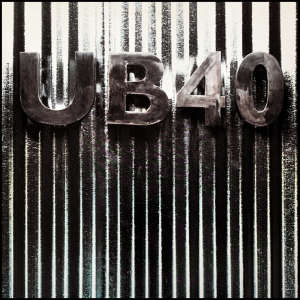
UB40
How you feel about UB40 largely depends on whether you view them as proto-pop sonic linguists, neo-traditional cultural appropriators, or post-modern stylistic interpreters. I tend to rate their early phase of output somewhat ambiguously between the first two genres, and their post-Labor of Love era of global domination firmly in the third. Them’s the breaks.
Then again, it might be a bit harsh to classify this innocuous nine-piece as a mere instantiation of musical parochialism. The mixed-race lineup originated in Birmingham, the same city that gave the world such innovations as the jet engine, the postage stamp, the microwave oven, long-distance rail travel, and nuclear fission. The city was decimated during World War II, then rebuilt, only to endure a series of bomb attacks allegedly carried out by the Provisional IRA in the 1970s. A deep recession in the early 1980s saw Birmingham’s local economy collapse, before one of the city’s periodic renaissances rejuvenated Birmingham as a global epicenter for trade, industry, and culture.
It is this period of Birmingham’s history where the UB40 story begins: a climate of civic unrest, population displacement, and double-digit unemployment that afflicted much of the United Kingdom during its Thatcher era.
Background
UB40 was formed in 1978 in south central Birmingham, England. The initial eight members, all unemployed at the time, famously named themselves after Unemployment Benefit Form 40. After sequestering themselves away for six months to learn their instruments, the band started performing live in early 1979. They caught the attention of Chrissie Hynde while playing in a Birmingham pub, which led to a support slot opening for the Pretenders on a brief tour. UB40’s first single “King / Food for Thought” was released in February 1980.
The musical territory occupied by UB40 exhibits all the attributes of dance floor reggae: standard four-beat rhythm, guitar skank on the upbeat, low-range application of horns, relaxed vocals, and a bit of lively toasting when the occasion and mood converged. The UB40 formula at the band’s inception was a bit rougher and less polished than when they covered songs by Neil Diamond and Jimmy Cliff, at least to these ears, and it is this period that I personally find to be more exciting than their subsequent work.
The UB40 album I own is a lesser-known compilation, released in 1983 to introduce the band to American audiences. It includes that previously mentioned first single, three tracks from their 1981 album Present Arms, three tracks from their 1982 album UB44, and two remixed tracks that had yet to appear on any album to that point in the band’s existence.
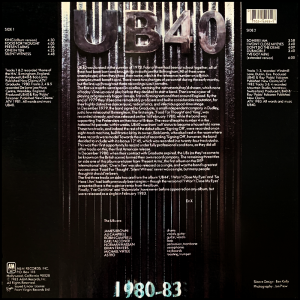
Tracks
“King” opens the compilation with its spacey-dub chord progression and a UB40 trademark: the smooth, almost cavalier vocal delivery of lead singer Ali Campbell. The lyrics address a generation’s motives left adrift following the assassination of Martin Luther King, Jr.: “You had a dream of a promised land / People of all nations walking hand in hand / They’re not ready to accept that / Dream situation, yet.” It’s a deceptively stern message given the bouncy, horn-driven melody in which its delivered, but the song’s overall impact is effective. For a group of unemployed kids who were still learning how to play music together, it’s an impressive first single.
The other half of the “King” single was “Food For Thought,” a song whose lyrics describe the hypocrisy of Christmas. As choruses go, this is some distance away from the vernacular of everyday pop songs: “Ivory Madonna dying in the dust / Waiting for the manna coming from the West.” The sound is distinctive yet accessible, as with “King,” and the lyrical content is topical without being overly preachy or didactic.
“Present Arms” begins with a rigid marching snare before transitioning to fairly standard mid-tempo reggae. It sounds like ska slowed down (or maybe ska is reggae sped up?), and I like the little organ hits that echo between the verses. Beyond the riff, however, the song demonstrates the limitations of UB40’s songwriting chops. Probably fun in the live setting of a dance hall; not sufficiently compelling as a studio recording.
“One In Ten,” however, is magnificent. I really love the lyrics, especially “Nobody Knows me / Even though I’m always there / A statistic, a reminder / Of a world that doesn’t care.” I usually don’t respond positively to such simplistic messaging, but the sentiments being conveyed work well in this case. It’s a big plus that the song features a deliciously nagging guitar riff accompanied by a full-bodied brass section. I might even argue that “One In Ten” is UB40’s finest moment.
“Silent Witness” follows that to close side one, and it’s another strong showing by a band that remarkably was still finding its voice. The melody and lyrics aren’t much, and the pace threatens to drag, but the insistent horn parts and little percussive elements add sufficient tension to make things interesting.
Flipping the record over, we get the opening track from UB44 entitled “So Here I Am.” The sound is more mature, the production much improved, but again there isn’t much beyond the opening riff. And maybe that’s the point of the band’s approach to pop music: find a groove and lock into it for three or four minutes. The interesting bit to me comes at the end, when the horns exit the track with a variation of the melody. It’s good, although it does wear after a while.
The music of “I Won’t Close My Eyes” is a bit languid for me in comparison, and the lyrics start to venture toward the banal: “Our cries for justice are shots in the dark / But our strength’s in our bite / And not in our bark.” That’s followed by “Don’t Do the Crime,” which sounds diluted and annoyingly repetitive to these ears. The UB40 formula gets a bit thin with repeated exposure.
Thankfully, the pace picks up with the excellent “Dubmobile.” This uptempo dub tune features toastmaster Astro in a terrific vocal performance, and it’s everything fun reggae-pop should be. The little synth blips and reverb effects add to the overall vibe, providing an idea of what might happen if King Tubby or Lee Scratch Perry had a younger, less ominously brilliant sibling.
“I’ve Got Mine” closes out this compilation, and it offers something new in the way of a faster tempo on the chorus. At this point, though, five or six tracks might be all the UB40 my ears can handle in one sitting. Honestly, I think I’d rather go back and hear “One In Ten” or “Dubmobile” a second time than anything else the band might offer. But hey, if you have a hankering for lightweight reggae-pop then this should scratch your itch.
Aftermath
UB40 became international pop stars with their cover of “Red Red Wine,” a song I find to be execrably dull and tedious. They sustained numerous personnel changes, incarcerations, legal battles, and other dramas typical with bands that manage to exist for nearly four decades. Founding members Campbell and Astro left and eventually formed a sort of UB40 self-tribute touring act. Sadly, Astro passed away in 2021.
I can’t argue with anyone who finds UB40 to be appealing. If you like that sort of sound and prefer your social justice lyrics to be of the nondescript variety, you’ll enjoy just about everything they did before Campbell left the band in 2008. (Campbell was weirdly and somewhat controversially replaced by his brother, Duncan).
I knew students in art school who blasted UB40’s 1986 album Rat In the Kitchen in the painting studios. I can recall hearing those antiseptic, non-confrontational staccato riffs punctuating the humid air, an atmosphere thick with the fragrance of mineral spirits and patchouli. It made me wonder what might have been, if only UB40 had embraced a little more risk in what was already a winning algorithm for chart success. But alas, we’ll never know.
Reply