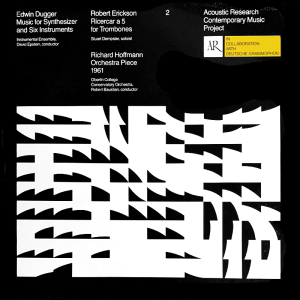
Edwin Dugger, Robert Erickson, & Richard Hoffman
If you type “acoustic research project” into the googles, all sorts of interesting stuff will emerge. There is the company called Acoustic Research, Inc., founded in 1954 and based in Cambridge, that manufactured loudspeakers during its 22-year existence. There is an effort funded by the Reef Environmental Education Foundation, launched to study the migration habits of an endangered species of grouper in the Cayman Islands. The NOAA launched a similar project to study the behavior of whales in the North Atlantic.
The Acoustic Research Project of interest here refers to a board of eminent American composers and music teachers, who provided select composers the funds and technical support to record and release new music. Recorded over the span of a decade, the series was made available to the public in 1970. It consisted of fourteen radio broadcasts and six vinyl releases, allowing composers direct access to modern equipment and exposure to audiences who otherwise may never have heard their work.
Funded by the same Cambridge company who lent the project its name, the Acoustic Research Contemporary Music Project now seems like a quaint relic of a more genteel era in American culture. I can’t imagine someone like, say, Spotify or Meta doing something like this today. Perhaps that’s why I picked up the second volume in the series during a relatively recent shopping splurge, which features works written by Edwin Dugger, Robert Erickson, and Richard Hoffmann.
Background
Edwin Dugger in 1940 outside of St. Louis. He studied at the Mozarteum in Salzburg, Austria from 1960 to 1961, receiving his Bachelor of Music from Oberlin College Conservatory of Music in 1962. After earning is Master of Fine Arts from Princeton University in 1064, Dugger briefly taught at Oberlin before commencing his thrity-five year tenure in the Department of Music at the University of California in Berkeley. He taught music composition, analysis, and founded the Berkeley Contemporary Chamber Players before his 2002 retirement.
Dugger produced over one hundred works of acoustic and electronic music during his career, boasting numerous commissions. He was the recipient of a Guggenheim Fellowship, a Naumberg Award, and an award from the American Academy of Arts and Letters. He is represented on this album by Music for Synthesizer and Six Instruments, a 1966 piece conducted by David Epstein.
Robert Erickson was born in 1917 in Michigan and studied composition at Hamline University in Saint Paul, Minnesota. After serving three years in the U.S. Army, Erickson returned to Hamline and earned a Master of Arts degree in music in 1047. He taught at various schools in Minnesota and California before founding the music department at the University of California, San Diego. Among his students were such luminaries as Pauline Oliveris, Terry Riley, and Morton Subotnick, who influenced an entire generation of composition based on improvisation, minimalism, and use of electronic media.
Erickson was one of the first American composers to use the twelve-tone system, a technique whereby all twelve notes of the chromatic scale are used in equally in a single piece of music. Invented by Arnold Schoenberg, the intention of the twelve-tone technique (also known as dodecaphy and twelve-tone serialism) is to prevent the emphasis of any one note and thus avoid music being written in any one key. He is also one of the first composers to recognize the creative possibilities of utilizing sounds recorded on tape in music composition. Erickson is represented on this album by Ricercar a 5 for Trombones.
Richard Hoffmann was born in 1925 in Vienna, Austria. The emergent spread of Nazism forced his family to emigrate d to New Zealand when he was ten years old. Already proficient on violin, Hoffmann received a Bachelor of Music from the University of New Zealand in 1945. He moved to the United States to study composition with Schoenberg, who also happened to be Hoffmann’s cousin. He taught at Oberlin for fifty years and was a visiting professor at many universities, including Harvard. He received awards from the Fromm Music Foundation Commission, the National Institute of Arts and Letters, and the Fulbright Foundation.
Hoffmann was a frequent traveler. A 1970 Guggenheim Fellowship sent him to Berlin, Vienna, and Cambridge, by which he had turned his focus to composing music for strings using computer-generated portions recorded at the Massachusetts Institute of Technology. The piece featured on this album, titled Orchestra Piece 1961 and conducted by Robert Baustian, was recorded with directional and non-directional microphones relaying to a continuously revolving loudspeaker in the middle of the auditorium.
Tracks
Music for Synthesizer and Six Instruments alternatives between slowly developing cadences and abrupt sonic shifts. The synth is more sympathetic than one might expect, and there are moments where it is difficult to glean the difference between acoustic and electronic instruments. I quite enjoyed when the ring modulation added new textures, especially when met with a blast of oboe or a wisp of violin and viola. There are three distinct movements in the piece, the final portion demonstrating greater lyrical and conceptual depth. At just over six minutes, this is the shortest work on the album and arguably its most accessible.
Ricercar a 5 for Trombones begins with deep throaty tones, and I was reminded of John Williams’ score for the 1977 film Close Encounters of the Third Kind (which scared the crap out of me as a child, I have to admit). The sound has an almost jazzy, bebop feel near the eight-minute mark, then things get very strange for the final portion. There are prerecorded tapes being manipulated, some sort of chanting or whispering in the background, and what sounds like a plunger being used to excavate someone’s lost jewelry from a sink drain. The trombones are pushed well past their sonic limitations, and maybe that is the point: finding percussive sounds from instruments that are normally not used for that purpose. The ending moments are quite beautiful.
At seventeen minutes, Orchestra Piece 1961 takes up all of side two. It is a single movement subdivided into three sections: a two-part exploration, a middle-slow portion, and a reprise. According to the composer, the musicians were seated in semi-circles and flanked by four percussionists to give the impression of multi-dimensional movement and to emulate a feeling of instability. Although such approaches often lead to music that is disorienting, I quite liked the spatial qualities explored in this recording. What could have been auditory chaos, I actually find quite soothing in parts. I was reminded of the more spontaneous work of Pierre Boulez, an important figure in the development of what was then called “controlled chance” music. As an allegory for randomness, Orchestra Piece 1961 surprises and delights in how “together” it frequently sounds.
Aftermath
Edwin Dugger retired from teaching in 2002 and passed away in 2021 at the age of 80. Roger Erickson passed away in 1997 at the age of 80, after being bedridden for fifteen years with polymyositis. Richard Hoffman retired from teaching in 2004 and lived less than a mile from the Oberlin campus, residing in a home he built in 1964 entirely out of aluminum. He passed away in 2021 at the age of 96.
I don’t harbor any illusion that this sort of music appeals to everyone. Whether your jam is Joni Mitchell or Sanguisugabogg, all I can say is: you be you. I’m not going to yuck anyone’s yum.
That being said, I had a delightful and enriching experience reacquainting myself with these works. According to sources, albums released by the Acoustic Research Contemporary Music Project are now relatively rare. If you happen to see one of these six volumes in your local vinyl shop, consider checking it out. At the very least, you’ll feel more cultured. And the album covers are pretty boss in a minimalist, late 1960s sort of way.
Reply