Tirez Tirez
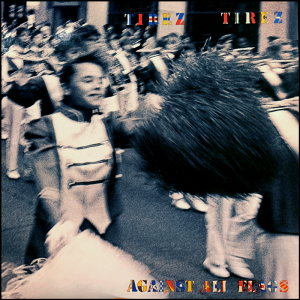
Those of us who bought records in the days before MP3 files, Internet streaming, and short-form videos discovered new music by one of two methods: either we read about it somewhere, or someone recommended it to us. If you were like me, you carried around a list. It typically consisted of albums and artists that were difficult, if not impossible, to find in domestic record stores. Everyone’s list was different, but those of us who cared about music all had one. I kept mine in my wallet.
By the mid-1990s I had amassed a fairly sizable list of rare music. I took it everywhere, just in case I happened to see an item from the list while visiting an unfamiliar city. That’s how I scored my vinyl copies of The Poison Boyfriend by Momus and Stratégie De La Rupture by Wim Mertens. I remember that Thessaloniki record shop well; it was called Ανω ΚΑΤΩ, a Greek phrase literally meaning “upside down” but more colloquially “fucked up.” The store was a tiny place with a lot of dust, smelling of mothballs and grilled meat, and they had an insane number of Blaine L. Reininger solo albums in stock.
In any event, one of the most prominent names on my list was a relatively obscure band called Tirez Tirez. I was going through my heavy Tuxedomoon phase, which exposed me to the Crammed Discs “Made To Measure” series, and Tirez Tirez fit into that same ilk of European-style avant-garde weirdness. Tirez Tirez founder Mikel Rouse seemed like an interesting dude, having worked with chamber quartet Broken Consort while also recording an entire album of LinnDrum solos titled Quorum.
Tirez Tirez albums were not easy to find, hence the list, and the band’s entire discography remains out of print today. Upon moving to Philadelphia in the 1990s, however, I knocked off nearly a third of my list in a single trip to the now-defunct Third Street Jazz & Rock. Among those purchases were Against All Flags and Story of the Year by Tirez Tirez, A Lincoln Portrait and A Walk In the Woods by Broken Consort, and Rouse’s “Made To Measure” collaboration with Reininger titled Colorado Suite. It was a good haul.
Background
Tirez Tirez (“pull pull” in French) was formed by Missouri native Mikel Rouse at the Kansas City Art Institute in the late 1970s. They had the honor of opening for Talking Heads in 1979, being the only local band considered appropriate for such a gig. Their earliest recordings (long out of print, although a few have turned up on YouTube in recent years) demonstrate evidence of an interesting, arty band that had yet to crystallize into anything noteworthy or original. File under “shows potential.”
Tirez Tirez went through a few lineup changes upon moving to New York City. Landing on the Belgium label Les Disques Du Crépuscule, the band released Story of the Year in 1983 as a quartet. I love that album, despite a slight rhythmic monotony among all the tracks; the best songs feature fascinating woodwind textures and lyrical themes. That said, at least one track borrows too much from Talking Heads, and Rouse’s own vocal mannerisms at this stage of his career resembled David Byrne’s. Rouse was still finding his niche, but the album was a promising step forward.
Rouse split his time between Tirez Tirez and Broken Consort the next few years. Finding a permanent home on the domestic label IRS (most notably the home of R.E.M.), Tirez Tirez shed some of the band’s more arty pretensions to release wonderfully obscure, polyrhythmic pop music. Rouse recorded 1987’s Social Responsibility almost single-handedly, and as a result there’s a certain sterility to some otherwise strong material. Rouse recruited a full band for the following year’s Against All Flags, and the improvement in both sound and execution is noticeable.
Tracks
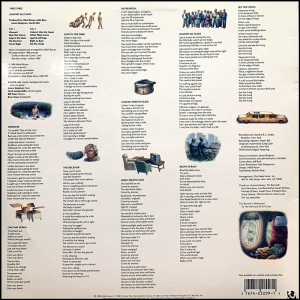
Against All Flags begins with “Missouri,” a song where Rouse observes the inner turmoil of growing up in the Midwest: “Playin’ for fries on the pinball / Sippin’ a coke at the Deer Run / How many times did we notice / All the commotion around us?” This is a common lyrical theme for Rouse: unearthing humankind’s intrinsic desire for greater meaning among a landscape of cornfields, county fairs, and cow-tipping. I’m reminded of the film What’s Eating Gilbert Grape, which takes place in a small Iowa town where the opening of a new fast food restaurant qualifies as a significant social event. The music has a swimmingly appealing atmosphere, a dense mix of accordions and keyboards supporting Rouse’s lovely singing voice.
“One Way Down” reduces the former track’s complexity to a simple little motif, without losing the pop sensibility. There’s some sort of brass horn accompaniment behind the verses, and it’s impressive how approachable this music is without compromising its overall aesthetic.
“Leap In the Dark” might be one of my two favorite tracks on the album, opening with a bluesy piano intro before Rouse’s voice takes control. He sings with great authority on this entire album, and the background vocals near the end of the track are simply divine. The lyrics get a little obscure at times, almost to the point of feeling cavalier (“Tell it to the mailman / He’s ready to work / Workin’ on the railroad / He’s splittin’ the ties / Knock about Charlie”). If there’s a deeper concept there, I’m not sure it’s coming across. Still, the sound is so wonderfully assembled you find yourself singing along anyway.
“The Receiver” amps up the adrenaline with what I believe might be processed vocals on the chorus. Being a collection of pop songs, it’s remarkable how complex these arrangements are upon close scrutiny. Each instrumental passage could almost be its own piece, right out of the minimalist handbook co-written by Steve Reich, Philip Glass, and Michael Nyman. This theme of repetition is something Rouse has explored for most of his career, regardless of what musical idiom he chooses to occupy.
“Never Begin” continues the lyrical preoccupation with place and identity: “I can’t keep lookin’ at Virginia / I can’t keep lookin’ at the south / I got my fill of paranoia / I got my fill so I got out.” Again, if there’s a deeper meaning to be gleaned regarding the human condition then I’m simply not getting it. I only mention this because on Rouse’s later work, most notably Failing Kansas, he expertly highlights the dichotomous interplay between language and psychology manifested as small-town desperation.
“Unless I Miss My Guess” opens side two, and it’s a jaunty little pop song that leaps off the vinyl with sprightly keyboards and a driving rhythm. I sort of long for more of a hook in the chorus; in fact, I might argue that this quality in their entire catalogue is what prevented Tirez Tirez from becoming a fixture on 1980s college radio. It’s the same thing that doomed Polyrock.
“When Pilots Came” recalls the sound of Story of the Year, with cyclical vibraphones setting the pace with slippery fretless bass. I love how the chorus appears to shift tempo amid its graceful chord changes, creating a mini-epic in a very brief three-plus minutes. Phrases like “Movies of you when pilots came” imply new levels of emotional depth behind their abstraction.
The album’s title track comes next, the second of my two favorite songs in this collection. The lyrics describe a romantic partner who might just be a little too invested in political or social issues (we all know the type). I love the chorus, especially the lines “It’s just all that waving / Is kind of a drag / Remember I’m neutral / I’m against all flags.” Musically, the sonic palette includes pleasantly strummed acoustic guitars, trebly picked electric guitars, 1980s synths being 1980s synthy, and some deceptively propulsive drumming. (In fact, the drumming on this entire album is one of its secret weapons). “Against All Flags” is a track that risks being repetitively boring, but it elevates wonderfully. A great pop song that should have been a hit.
As should have “Right As Rain,” perhaps, especially given that the verses feature Rouse offering a spot-on imitation of John Lennon’s Sgt. Pepper-era vocal mannerisms. The groove is sufficient, but again this is a song whose chorus needs more of a hook. This may be the weakest track on the album, in fact. It needs something: a change of tempo, a different key on the bridge, a variation on the sing-song verse-chorus structure, another vocalist (female, perhaps?) singing harmony.
“See the Living” closes Against All Flags, and it’s a nice way to wrap up a terrific album. The structure of this song is a bit more ambitious, almost moving into progressive rock territory. I quite like how it begins, the counterpoint guitars and piano stabs breaking down into the “doo-do-doo” vocal bridge before the drums kick in. Once again, the cryptic lyrics appear to imply more meaning than what they may actually convey, but also once again the song wins in the end. Tirez Tirez in a nutshell.
Aftermath
Tirez Tirez stopped operating as a band entity following Against All Flags, but Rouse’s career was just beginning. Today he is a highly regarded composer of conceptual operas using a technique he calls “counterpoetry,” where individual lines sung by each character are phased against a consistent time signature. He has also released several avant-garde solo albums that meld highbrow art with the vernacular of pop music.
I saw Mikel Rouse in concert in 1997 at the Annenberg Center in Philadelphia, where he performed three pieces with local chamber ensemble Relâche. Afterward I got to speak with him a bit and mentioned Tirez Tirez. “Oh, you’re going to make me feel old!” he laughed, indicating that maybe this part of his life was behind him and better left in the past. Over the years, my friend Wolfgang and I have semi-seriously discussed starting a Tirez Tirez cover band. I wonder how Rouse would respond to such an idea, although it’s probably a good thing that I didn’t mention it at the time.
Rouse has enjoyed something of revival of late, having reissued much of his back catalogue on Bandcamp and recently publishing his autobiography. The Bandcamp roster includes many Tirez Tirez and Broken Consort recordings, and both Story of the Year and Social Responsibility can be found on YouTube in their entirety, ostensibly uploaded by fans of the band. It gives me pleasure to know that maybe other people had Tirez Tirez their lists, and that long-underappreciated talents like Rouse can eventually achieve the recognition they deserve.
Reply