The Glove
When I was six years old, I happened to be up late at night watching a broadcast of the Beatles’ animated classic The Yellow Submarine. The film’s plot features the four protagonists undergoing a surrealistic journey through a Heinz Edelmann landscape, fighting a territorial war against hideous little gremlins called the Blue Meanies. During the final battle, the Chief Blue Meanie unveils his secret weapon the Dreadful Flying Glove, which Cartoon John Lennon defeats by extracting the “g” from the Glove’s name. It sort of freaked me out, to be honest.
Ten years later, I was listening to The Top by English band the Cure. It had the same creepy psychedelic vibe of the The Yellow Submarine, but with a darker and more foreboding mood: the lyrics of the album included references to domestic violence, self-mutilation, and drug-induced psychosis. If The Yellow Submarine was an imaginative fairy tale of love, hope, and peace, The Top was a wall-bleeding acid trip gone very wrong.
Connecting these two sensorial milestones is the Cure’s Robert Smith, who at the time was leading his own group while serving as semi-permanent guitarist in Siouxsie and the Banshees. Anchored by vocalist Siouxsie Sioux, bassist Steven Severin, and drummer Budgie, the Banshees featured John McGeoch on guitar before a nervous breakdown in 1982 necessitated his replacement. Smith can be heard on the Banshees albums Nocturne and Hyæna, and Severin made a few Cure appearances in the absence of departing bassist Simon Gallup.
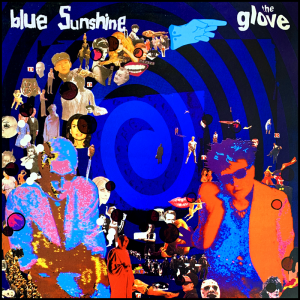
The Glove is a collaborative side project between Smith and Severin, their partnership producing one full-length release entitled Blue Sunshine. The album is named after a cheesy 1977 horror film, in which homicidal maniacs commit a series of murders after they’ve taken a mysterious batch of LSD.
Background
Both Severin and Smith were reportedly under heavy stress in the early 1980s, most likely due to the strenuous touring and recording schedules of their respective bands. I would suppose that chemical dependency and heavy intake of alcohol, both occupational hazards of the music industry, did not help their mental states at the time.
The Glove was intended to be a fun diversion, and for the most part the material exhibits a sort of whimsy not detectable in their respective bands’ output. Severin wrote the lyrics to most of the songs, and both contributed bass and keyboards. Cure drummer Andy Anderson contributed as a session musician, and a string quartet appears on a few tracks.
Smith was contractually prohibited by his record label from singing on more than two tracks on Blue Sunshine. Two tracks are instrumental. The remainder of the album is sung by Siouxsie soundalike Jeanette Landray, a dancer who regularly appeared on the British television program Top of the Pops.
Tracks
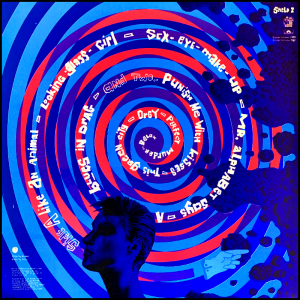
The sound of a hyperactive drum machine kicks off “Like an Animal,” the first single off the album, before exploding into the sort of thing you would expect from early 1980s Severin and Smith: washes of keyboards, heavily flanged bass, electronic drums, and bits of strangulated guitar. Call it techno-goth-pop. Landray’s vocals are appropriate for the bizarre yet poetic lyrics: “One mile in the air that’s where she lives / Her body looks so thin and pink and small / Dropping eggs from nervous shaking hands / And swallowing her fingers as they fall.” This was one of three songs where Smith contributed lyrics, and if you’re familiar with the Cure’s work of this period then you’ll feel right at home here.
“Looking Glass Girl” slows the pace down, and this is where a Beatles psychedelic influence starts to emerge. A string quartet adds an effective Revolver-era element, and I like how the melody sounds both pretty and ominous.
That’s followed by the slinky and sultry “Sex-Eye-Make-Up,” which lyrically resembles the Velvet Underground’s “Sister Ray” passed through a William Burroughs filter. People are screwing on the stairs, smoking cigarettes inside burning cars, smashing glass about the place, and having seizures while covered in blood. Sounds like a fun time.
“Mr. Alphabet Says” is one of two tracks to feature Smith on lead vocals. This time the Beatles influence is more “Lady Madonna,” with its insistent beat and schoolroom piano pounding out the melody. I really love the descending cadence of strings after the chorus, and of course we have hallucinogenic lyrics like, “Mr Alphabet says ‘Smile like a weasel’ / As I cover you / Cover you in treacle.’” Whatever you say, Rob. Regardless, the song is a delight.
At this point I must mention the strange little interludes between each track, which sound like a sped-up television theme song played through a cheap transistor radio. Maybe this was a slight nod to the 1960’s influences that appear on the front cover collage. Although they were probably throwaway bits the duo elected to preserve as a form of absurdity, I actually find these tiny snapshots quite compelling, and they serve a key role as the album’s connective glue.
Side one closes splendidly with “A Blues in Drag,” a very pretty and somber instrumental featuring a circular bass riff with heavily echoed piano and a treated violin solo. The overall effect is quite moving, and it’s the perfect way to close an excellent suite of songs. Weird title, though.
Side two opens with a repetitious synth arpeggio that introduces “Punish Me With Kisses,” the second single from Blue Sunshine. Landray returns to the microphone, making this the track that most resembles Siouxsie and the Banshees. Although it doesn’t quite move me as much as anything on side one (probably due to the comparatively calm lyrics and irritating little claps), it’s agreeable enough.
We are then treated to what sounds like a recording from a television program, which leads into “This Green City.” This one doesn’t wholly work for me; it sounds like a unfinished Simple Minds demo, and Landrays’ limitations as a vocalist are a bit exposed. It’s a shame, as I can hear potential.
“Orgy” follows, bringing us back into Naked Lunch territory: “A disease is under my fingernails / It stains me like a tattoo … A tongue explodes into my mouth / A taste of coma and tears.” These delightful sentiments are framed within a musical environment that’s wonderfully wild, with touches of Middle Eastern exotica and strange noises percolating all around. I love the deep fuzzy bass note that accompanies the chorus. Landray’s vocal style is much better in this setting.
Smith makes his second appearance as a singer on “Perfect Murder,” which has a vaguely Asian feel amid rotating synths that build promisingly but ultimately don’t land anywhere. The outro has some Cure-type yelping, but I would have liked the polyrhythms to develop a bit more. Also, the stop-start structure of the melody is somewhat annoying to these ears.
The instrumental “Relax” closes the album, and this is the part of Blue Sunshine that most embodies its titular psychoactive influence. It begins with the sound of a church bell followed by some sort of koto, lots of clanging percussion, ominous electric guitar, sinister dialogue pulled from a foreign movie you’ll never identify, and blasts of white noise with extreme flanging. Everything is in minor keys, and there’s all sorts of whispering and shrieking and disorienting sound effects. And just when you think the chaos is about to reach a respite, the demons pounce back into your face for two more minutes. Upon hearing this track, my roommate Krystoff at the time said, “They should have named the album Please Buy This Record and Support Our Heroin Addictions.”
Aftermath
Smith left the the Banshees in 1984 to concentrate full time on the Cure, who continue to punch out albums to this day. I confess I lost the plot with their music sometime after 1986, although I acknowledge their 1989 album Disintegration as a fully realized statement of purpose. I don’t know that all their material has dated equally well, at least to these ears, and the Robert Smith visual personage does feel a bit tired. But that might simply be me getting old.
Severin stuck with the Banshees until their 1996 dissolution. He then created his own record label and released a series of albums, mostly containing moody instrumental music for films. His is also the author of several articles that have appeared The Guardian and The Independent. It warrants mentioning that Severin was also an early proponent of artists using the Internet as a distribution vehicle.
Although Severin and Smith later moaned that they felt Blue Sunshine was self-indulgent and overly eccentric, the album attracted fair-to-decent reviews from critics upon its release. At least one reviewer cited Blue Sunshine as a landmark of psychedelic pop alongside Piper at the Gates of Dawn, Sgt. Pepper, and Surrealistic Pillow. I’m not entirely convinced Blue Sunshine warrants quite that level of praise, but it’s still a fun trip.
Reply