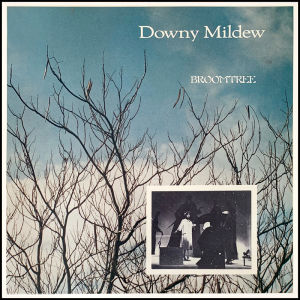
Downy Mildew
In the late 1980s, there was something called “college rock.” Less genre than delivery vehicle, college rock provided an avenue for bands outside the mainstream to reach larger audiences. While commercial radio for much of the decade’s latter half was saturated with hair-metal bands and synthetic dance-pop music, a more diverse and eclectic mix could be heard being spun by university disc jockeys. Anything from industrial noise to avant-garde electronica to mopey hardcore was fair game on the airwaves of academia.
One flavor of college rock was a brand of music with a decidedly underground sensibility, combining the atmospheric richness of, say, the Cocteau Twins with the familiar jangle and twang of acoustic folk. Arty yet accessible, these bands inhabited an space where they were free to embrace their post-psychedelic tendencies: a sonic palette comprising delicate, shimmery tinsel with the confident strum of a twelve-string guitar.
I’ll ask you to park that in your mind for just a moment, because now I’m going to talk about plant fungus. Downy mildew is a disease of the foliage caused by prolonged leaf wetness, spread from plant to plant by airborne spores. There are several strains of downy mildew, each affecting a narrow host of edible and ornamental plants: brassica, grapevine, lettuce, onion, tobacco, and other species are subject to the blotchy discoloration and shriveled decay of downy mildew.
Now I’ll ask you to imagine a band called Downy Mildew. What sort of sound would this group produce? In what portion of the college radio underground would they reside? If you envisioned a beautifully murky style of California gothic pop drenched in reverb, with lyrical content ranging from inconsequential to obtuse, you win a pair of checkerboard Vans signed by Katherine Rye Jewell.
Background
In addition to hiking trails and expensive wineries, the California town of San Luis Obispo also features a downtown shopping area highlighted by Bubblegum Alley: a 15-foot high and 70-foot long wall lined with chewed gum left by tourists and Cal Poly students since World War II. This organic, living ecosystem of masticated rubber has gradually become the central attraction in this small town. For some reason, I feel the origin of the band Downy Mildew should start here.
Downy Mildew was formed in the mid-1980s by the songwriting team of Charlie Baldonado and Jenny Homer, both on guitar and vocals. They were joined by Nancy McCoy on bass and Mike Marasse on drums. The band released a self-titled EP on the Texas Hotel label in 1986, drawing attention to their chamber-pop sound that placed them firmly within the Paisley Underground scene of Los Angeles.
Broomtree is the band’s first proper album, released in 1987, and it demonstrates a clear affinity with that college rock sound of the time: crystalline guitar textures, poetic lyrics that wander around vague concepts, and a tendency to succumb to one’s echo effects pedal. In that regard, Downy Mildew can be easily lumped in with bands like R.E.M., 10,000 Maniacs, the Church, Dream Syndicate, and Game Theory.
The band’s secret weapon, however, was Homer. Her vocals provide a strong and distinctive contrast from those of Baldonado: he being the more pedestrian singer while Homer operated as vocal foil. The two together bring to mind the classic Jefferson Airplane duo of Grace Slick and Marty Balin, albeit less histrionic and more closely aligned with their band’s instrumental subtleties.
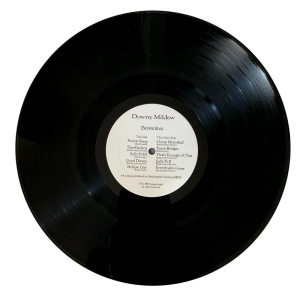
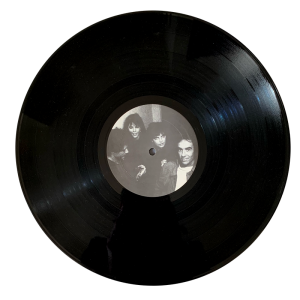
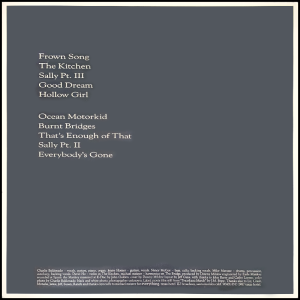
I purchased my vinyl copy of Broomtree sometime in the early 1990s. It has a photo of the band on side two of the disc label, with the entire album’s track listing on side one. As with all of Downy Mildew’s releases, the album cover art looks like a good idea that someone had no idea how to execute.
Tracks
Broomtree begins with “Frown Song,” quite an auspicious title to kick off an album. Baldonado takes lead vocals with Homer on harmony, and the effect is immediately striking. I quite like how it builds to the middle refrain, offering some interesting chord progressions while Marasse bashes away on his kit. Whatever Baldonado’s singing about, I have no clue, but given the context it’s probably about a relationship gone sour. The 1980s were a sensitive time for us all.
Homer takes her turn singing lead on “The Kitchen,” a quietly elegant acoustic number. Compared to the remainder of her material on Broomtree, it offers a starkly melodic simplicity.
The hooky “Sally Pt. III” accelerates the pace considerably, and its a welcome shift in momentum. Baldonado steps back in front to sing effective lead, with Homer exploding on the chorus to create a sense of tension that is wonderfully sublime. I might argue, in fact, that this is the best moment in Downy Mildew’s entire career. Or perhaps it’s “Good Dream,” which brings Homer back as lead vocalist against a dizzying tapestry of kaleidoscopic guitar figures. Four songs in, and it’s evident that Downy Mildew were capable of occasional greatness.
That progression starts to dull a bit on Baldonado’s “Hollow Girl,” which to these ears closes the album on a damp note. It’s not horrid by any means; it simply fails to advance the journey teased by the excellent tracks that precede it.
Flip the record over, and we’re met with the gaseous cloud that opens “Ocean Motorkid.” Homer’s voice operates like another instrument in this wondrously dense and atmospheric piece, the cymbal crashes and chiming echoes reflecting like incandescent pools of oil. It’s a formula that the band admittedly reiterated for most of its existence, but on this occasion all of the elements coalesce to perfection. This one really works.
“Burnt Bridges” is another hooky rocker by Baldonado, only this time Homer’s presence is relatively more subdued. The surprise here is a harmonica solo (!) that surfaces Downy Mildew’s closeted persona as an upbeat folk-rock band. It’s probably a cliché they picked up from the Plimsouls (another guitar-centric Los Angeles band from that era), but I dig it anyway.
You may have noticed by now that I haven’t offered sparkling commentary on the lyrics of Broomtree. Truth is, there isn’t much there to unpack. “Burnt Bridges” offers the banal sentiment “You say you’ve burned your bridges / Well you’ll just have to cross them again.” With bands like Downy Mildew, I typically don’t notice their lyrics unless they’re either really good or really bad. For the great majority of Broomtree, I don’t entirely care what Baldonado and Homer are singing, and I take it as a net-positive.
“That’s Enough of That” doesn’t quite possess the verve or drive of the previous two tracks, and this is where Broomtree starts to decline a bit for me. The song is based on a few simple guitar chords punctuated by Phil Spector-style drum hits. The effect is heavy on reverb and gravitas, without the impact of the album’s more successful tracks. Homer’s vocals are nice, however.
“Sally Pt. II” is a somber piano version of “Sally Pt. III” (jeez, who is this Sally person?), sung by Homer with slightly different lyrics. The band’s pretensions as an art combo take over, accompanied by a string section and what sounds like glockenspiel.
“Everybody’s Gone” closes out the album with Baldonado singing “You are my best friend / And you’ll be till the very end,” which is all I’m going to say about the lyrics. This song closely approximates the sunny vibe often attributed to 1960’s California pop, right down to the “bah bah bah-bah” vocals on the chorus and a flamenco-style acoustic guitar solo. I like Homer’s soft background vocals and the left-right interplay of the guitar parts. It’s a well-produced piece of music, but again this song just doesn’t move me as does most of side one.
Aftermath
Downy Mildew released their second album Mincing Steps a year after Broomtree, expanding their sonic palette with strings and a new drummer. The sound was more ambitious, showing evidence of the band breaking away from their more clichéd tendencies. The songwriting was not as strong, however, and they tended to fall into patterns of predictability: a toe-tapper by Baldonado, a vaporous dirge by Homer. Rinse and repeat.
The band then signed to a subsidiary of Windham Hill Records, of all labels, for whom they released two albums clearly targeting the Starbucks demographic of aging suburban Gen Xers. Slow Sky is by far the better of the two, and a number of Downy Mildew fans consider it to be the band’s best release.
Downy Mildew ceased operations in 1995, although they have occasionally reformed for one-off gigs around the Los Angeles area. Homer subsequently formed a new group called Something Died In Memphis. I’ve never heard their music, although a Facebook page from 2016 features many photos of the group wearing black lace and hanging out in graveyards. That’s always a troubling sign.
Despite its flaws, I find the best parts of Broomtree to be the most exciting and compelling music of Downy Mildew’s career. I don’t know why they never became a college rock institution; curators of the MTV program 120 Minutes should have been gagging for bands like this. The strongest songs on the album are on par with anything released during that period. Like San Luis Obispo’s Bubblegum Alley, it’s a richly textured reminder of a less complicated era. Also like Bubblegum Alley, it makes you a bit queasy if you get too close to it.
Reply