Laura Nyro
If you were to twist my arm (and please don’t), I’d contend that Laura Nyro is the most significant American songwriter of my lifetime. A strong statement, perhaps, but I can back it up.
The Bronx-born daughter of a piano tuner and bookkeeper, Nyro’s songs became hits for the 5th Dimension, Barbara Streisand, Peter, Paul, & Mary, Blood, Sweat & Tears, and Three Dog Night. It is worth noting that she accomplished this feat before the age of 24, having written many of her best-known works while still a teenager, and her early albums remain 1970s rock milestones to this day.
Nyro’s influence goes beyond artists who merely performed her songs. Her distinctive piano playing and composition style directly inspired a young Todd Rundgren, who wrote a song about her on his debut solo album Runt. Along with his own extensive discography, Rundgren went on to produce such seminal acts as the New York Dolls, Hall & Oates, Badfinger, the Psychedelic Furs, the Tubes, and XTC. Nyro additionally helped launch the career of R&B legend Patti LaBelle, whose funk group LaBelle provided background vocals on Nyro’s album Gonna Take a Miracle before enjoying newfound chart success.
I would further argue that Nyro kicked down the door for strong, artistically-minded female artists of the 1970s and 1980s. Joni Mitchell, Carole King, Suzanne Vega, Kate Bush, Sarah McLachlan, Diamanda Galas, Rickie Lee Jones, Donna Summer, Tori Amos, Joan Armatrading, Cyndi Lauper, and countless others reflect Nyro’s influence and aesthetic: an assertive (but never polemic) celebration of the feminine self. Nyro was tough as nails and comfortable in her own skin, yet she never hesitated to show vulnerability as an instrument of compassion.
This review examines one of Nyro’s classic early 1970s albums, Christmas and the Beads of Sweat, her fourth solo release and the third of a trilogy. The album combines two essential Nyro attributes: an appreciation of R&B songs from her youth, and the ornamental arrangements she often applied to her more evocative, sometimes intense material.
Background
Released in November 1970 by Columbia Records, Nyro’s fans would have been forgiven for expecting Christmas and the Beads of Sweat to be a holiday-themed album. (The fact that Nyro was known to wear Christmas tree ornaments as earrings may have compounded the Yuletide anticipation). As it turns out, the theme of Christmas is employed as a motif of rebirth for both nation and soul.
The United States in 1970 was a dark time in American history. Along with an unpopular and controversial war in Vietnam, which by this point had now spread into Cambodia, uprisings in cities across the country were instigated by generational tensions involving gender and race. The killing of university students at Kent State and Jackson State, the government crackdown on the Black Panther movement, the Chicago Seven counterculture protests, increasing anger among Native Americans, and the start of prolonged economic stagflation all contributed to a climate of uncertainty.
Nyro was very much a product of this time period, often aligning herself spiritually with causes that resisted draconian militarism. Her previous work had danced around the edges of social commentary; “Save the Country” from New York Tendaberry and “Poverty Train” from Eli and the Thirteenth Confession are notable examples. Although these two albums were highly acclaimed and netted Nyro some much-deserved critical adoration, Christmas and the Beads of Sweat represented a more intentional encapsulation of the personal and political issues Nyro feared would ultimately tear her world apart.
Christmas and the Beads of Sweat is split into two inclusive and distinct sides of music, each delivered by a different set of musicians and producers. Side one presents five relatively conventional songs performed by Nyro on piano, backed by a band from Alabama called the Swampers. Given that the Swampers had previously worked with Dusty Springfield and Cher, side one might be considered the more commercially marketable portion of Christmas. Side two explores more challenging musical terrain, with longer tracks featuring ambitious song structures and instrumentation.
Along with the Swampers, Nyro’s supporting cast reads like a “who’s who” list of all-star session musicians from the early 1970s. The album features Felix Cavaliere and Din Danelli from the Rascals (a top-ten pop band from that era), members of the Muscle Shoals Rhythm Section, jazz legend Alice Coltrane on harp, and Duane Allman from the Allman Brothers on guitar. Side two’s more ornate arrangements include woodwinds, vibraphones, bells, and orchestral percussion. At the center of everything is Nyro on piano and vocals.
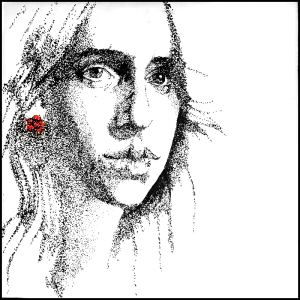
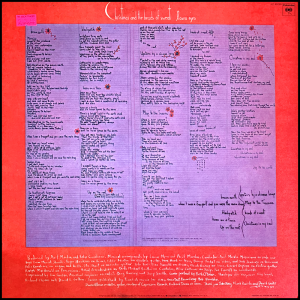
My copy of Christmas and the Beads of Sweat is pretty old, having been purchased in a used record shop, and the cover is a bit worse for wear. All the marks and smudges accumulated over the years, however, only accentuate the stippled pen drawing and hand-crafted lettering of the cover’s original design. Combined with the matte surface texture of the record sleeve, the package looks and feels like an artifact of time captured, like an old scrapbook discovered in a dusty attic.
Tracks
“Brown Earth” is the tasteful opener to side one. As with many of Nyro’s songs, her bittersweet impressions are sung as abstractions: “Morning came to the windows of the street / Selling red watermelon, five cents a piece / Merry boat on the river, freedom / Fresh dreams to deliver, freedom.” And like many of Nyro’s lyrics, hope and reminiscence take center stage. By the time Nyro gets to the closing repetition of “White doves gonna come today,” guitars and vibes play counterpoint against a rotating up-and-down piano riff, creating a feeling of warmth.
The oddly named “When I Was a Freeport and You Were the Main Drag” is an upbeat and classy pop song, offering the brilliant couplet: “I’m mad at my country / Now I’ve been treated bad.” It’s a deceptively simple line that melds Nyro’s political and personal concerns into one delicious gripe. The horns arrangement is spot-on, sounding both sympathetic and sassy, and this song is the closest the album comes to providing a classic Nyro toe-tapper. The track closes with Nyro unleashing one of her trademark wails; she clearly has had enough of the chump that did her wrong, and I don’t blame her.
“Blackpatch” is phenomenal, a mini-theatrical drama that makes its point in a mere three-and-a-half minutes. The opening is almost polite, Nyro whispering against subdued accompaniment before the horns make their entrance. This is where Nyro brings the gusto: “Now tugboats paint the river / Carry coal to the city and white dock liners / Happiness on the uptown side / At my party in the morning tide.” That’s real poetry, friends, but the best part is yet to come. After the second verse, everything quiets down to a hush as Nyro shyly asks, “People are you ready? People are you trying?” Then the entire ensemble explodes into a cacophonous refrain, cymbals and brass and vocals bouncing all over the mix. On the final verse, I absolutely love the piano roll after Nyro sings “Woman child on the side street,” as well as the stylized outro that fades out the track. Nobody else wrote songs like this in 1970, and the immediacy of “Blackpatch” is all the more astounding upon realizing that its chorus appears only once.
“Been on a Train” is a somber, reflective blues tune. The lyrics are sung from the point of view of someone on a train trying to prevent another passenger’s drug overdose. The instrumental bit after Nyro sings “No, no, damn you mister / And I dragged him out the door” is genuinely haunting and compelling.
Written by Gerry Goffin and Carole King, “Up On the Roof” is given a dignified, almost sedate reading. It seems unfair that this cover version of a classic song was the only charting hit single in Nyro’s brilliant career. Despite this cruel irony, “Up On the Roof” deserves its place on the album; one can feel a past-present boundary being crossed as the song closes side one.
Side two opens with “Upstairs By a Chinese Lamp.” There is a spare intro of piano and wind chimes before the vocals kick in, Nyro’s voice singing at her highest register about a “Sleepy woman by the window / dreaming in the morning air / of the man who takes her sweetness / by a Chinese lamp upstairs.” The track has a vaguely Asian feel, with its descending chord structure embellished by hints of flute, woodwinds, Alice Coltrane’s harp, and what sounds like a koto.
Coltrane’s harp bridges into the next track, “Map to the Treasure.” The opening verses are again sung quietly, and Nyro intentionally uses the dead space to create tension between notes. As her playing accelerates, however, we are treated to an extended piano solo that almost makes me think of Philip Glass. The piece is more sound sculpture than pop song, the silences as important to its composition as what’s being played or sung.
A rich organ introduces “Beads of Sweat,” continuing what is evidently a side-long suite. The song’s bouncy pace is more reflective of what we might expect of a 1970s rock tune. Nyro’s lyrics, however, foretell upcoming danger: “Something’s comin’ I know / To devastate my soul.” Just to drive that point home, Duane Allman echoes Nyro’s vocals on lead guitar while she offers an bleaker outlook: “Searching for a miracle / A pearl in an oyster / And we all looked up to God / Although He is the color of the wind.” Such radical skepticism might have seemed nihilistic compared to Nyro’s peace-and-love contemporaries, but she had the street smarts to pull it off.
Things don’t get any cheerier in album closer “Christmas In My Soul,” in which Nyro sings about “The missing love that rings through the world.” Nyro faced some disapproval from critics at the time for being too serious, and I suppose that Columbia Records would have preferred that Nyro put a bit more fun into her compositions. Singing stuff like “ I walk the streets where disrespect has been / The sins of politics, the politics of sin / The heartlessness that darkens my soul” probably didn’t help. It does get a bit overbearing, perhaps, but to these ears Nyro atones for any perceived indiscretion after the five-minute mark. That’s when a beautiful chord progression on piano is accompanied by Nyro’s multitracked vocals, offering a small semblance of hope as the album’s final chimes are struck.
Aftermath
Less than one year following the release of Christmas and the Beads of Sweat, Laura Nyro recorded an album of R&B covers titled Gonna Take a Miracle. Increasingly uncomfortable with being marketed as a celebrity, Nyro then announced her retirement from the music industry and disappeared from public life. She resided quietly in a small Massachusetts town for the next three years, during which her first marriage ended. The release of Smile in 1976 marked her return to the studio.
After giving birth to her son in 1978, Nyro again took an extended break from recording. She re-emerged in 1984 with the release of her album Mother’s Spiritual and began a 17-year relationship with painter Maria Desiderio. Nyro sadly passed away from ovarian cancer in 1997 at the age of 49, the same age as when her mother passed from the same illness. Her ashes were scattered around a tree on the Connecticut farm she shared with Desiderio.
Christmas and the Beads of Sweat doesn’t quite match the highs of Nyro’s essential albums Eli and the Thirteenth Confession and New York Tendaberry. That might be why Christmas is considered, in comparison, to be the most overlooked and underrated of Nyro’s releases. When remastering Nyro’s early albums in 2002, in fact, Columbia Records didn’t even include Christmas as part of their reissue series. What this neglect does, oddly and perhaps justifiably, is render Christmas as a sort of secret treasure: each song opening another door in Nyro’s artistic Advent calendar to reveal the gifts within.
Reply