Herbie Hancock
Most artists are fortunate to enjoy success in a single discipline, let alone more than one. Over his lengthy career, Herbie Hancock has managed to leave a sustainable imprint in multiple genres: jazz, hard bop, jazz-fusion, electronic, jazz-funk, and hip-hop. Hancock’s esteemed presence as composer and performer is equaled by his deserved reputation as a technological innovator. This is not surprising, perhaps, given that he holds degrees in both electrical engineering and music composition.
Although the lines are admittedly blurry, I generally split Hancock’s recorded output into three categories. The first represents Hancock the classically trained jazz pianist; this is the Hancock who was hand-picked by Miles Davis to join his Quintet in 1963. Hancock’s second phase illustrates his fascination with electronic musical textures, bookmarked by the 1973 release of his jazz-funk crossover milestone Head Hunters. The Apple Macintosh features prominently in Hancock’s third phase, along with his embrace of rap as an emergent art form. Those of a given age might recall how his 1983 single “Rockit” introduced breakdancing and turntablism into mainstream pop culture.
Although I am a fan of just about everything Hancock has recorded, for this review I chose to examine a comparatively overlooked offering from his Blue Note period. It is quite possibly one of my favorite jazz recordings ever.
Background
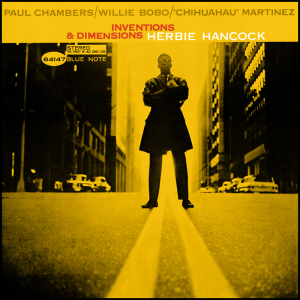
Hancock was already an established name at the age of twenty-three, having developed his own post-bop style on Takin’ Off and My Point Of View. For Inventions & Dimensions, his third album for Blue Note, Hancock pursued a cerebral, almost abstract, approach to free-form improvisation. As he stated in Nat Hentoff’s liner notes, “I told the musicians not to assume anything except for a few rules I set for each piece, and every time, those rules were different. There were no specific chord changes, nor did any of the tunes have a melody to begin with.”
The outcome from that one-day session was more experimental than anything Hancock had previously committed to vinyl. Much of the credit must go to the musicians he assembled: Paul Chambers on upright bass, Willie Bobo on drums and timbales, and Osvaldo “Chihuahua” Martinez on percussion. The inclusion of Martinez was an inspired choice, as his contributions lend a Latin flavor to all the recorded tracks. That said, Inventions & Dimensions is not exactly what one might call “Latin music,” nor does it adhere to rhythmic structures commonly found in jazz of that time period.
It is worth underscoring that the entirely of Inventions & Dimensions was recorded in a single day in August 1963, with almost no music written prior to the day’s session. What is remarkable is how these five improvisational pieces quietly build drama, suspense, form, and logic from quite simple concepts, often with little direction other than “play something.” The album still sounds intentionally composed, each piece reaching a satisfying yet unexpected conclusion. Listening to the album is a bit like watching an artist create a masterful landscape with only three colors of paint, no sketches, and a single brush.
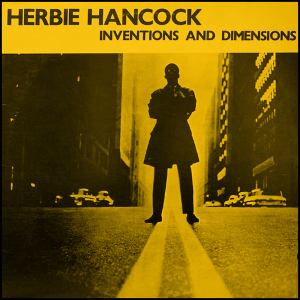
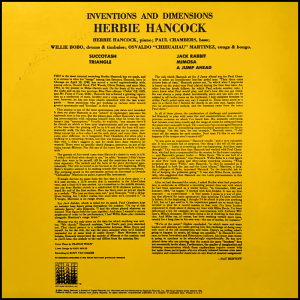
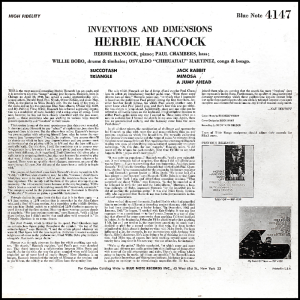
I have two vinyl copies of Inventions & Dimensions: an original 1963 pressing on the Blue Note label, and a 1982 reissue on the Applause Records label. Both have the same tracklist, sequence, and cover art, although the typography is slightly different and the back cover is yellow on the Applause version. I also own a compact disc reissue from 1997 that includes an alternate take of “Mimosa” as a bonus track.
Tracks
The album leads off with “Succotash,” whose title was inspired by the sound of Bobo’s brushes resembling the words “succotash, succotash” as he lightly tapped his snare. The only instruction Hancock reportedly offered the musicians was to play in 6/8, the melody forming spontaneously from Chambers’ bass and Hancock’s repeated piano phrasing. Just after the one-minute mark, Chambers and Hancock simultaneously transition into a comfortable setting to launch a wondrous solo from Hancock. I love how he builds tension by stepping up and down the scales near the three-minute mark before bringing everything back to the intro theme. Martinez is the perfect coloring agent to this sonic sculpture, sympathetic to the rhythmic interplay while never overpowering his fellow members.
“Triangle” is an extended piece in three parts: a 4/4 section that most closely resembles bop-jazz, a 12/8 section that is decidedly more Afro-Cuban (courtesy of conga drums played by Martinez), and a final 4/4 return to the first section’s more traditional jazz style. The segment just after the seven-minute mark is simply divine, Hancock’s classical training plainly evident in they way he shifts from a tonal pulse pattern to clusters of modulated chords. Listen carefully to how Hancock alters his playing from hard to soft to signify to the band when a transition is coming.
Flipping the record over, side two of Inventions & Dimensions leaps out of the speakers with the brisk “Jack Rabbit.” Chambers’ bass pattern never changes for the entirety of the piece, allowing the others to essentially play whatever they want. Still, each player shows tremendous restraint. The dual percussion solo after the three-minute mark is a particular highlight. Having taken African drum classes, I recall my instructor once telling me, “A solo is nothing more than demonstrating that you have command over your sounds.” Bobo and Martinez are in full control of what they’re doing, and when the entire band concludes together one can sense the energy that must have been felt in the room.
According to the liner notes, “Mimosa” was the only piece for which any music was written in advance. Hancock’s and Chambers’ parts were somewhat scripted, with Martinez and Bobo keeping pace with the bass-piano textures. The versatility of the two percussionists is evident on this entire album, in fact. Bobo, especially, handles intricate Afro-Latin textures as well as relatively straight-ahead rhythms. Not many casual fans are aware of Bobo’s contributions to the jazz world, but his list of discography credits as both artist and contributor supports his comparatively stealth reputation as a drumming legend.
“A Jump Ahead” closes the album. The only rule for the piece was for Chambers to begin with an introductory four-bar pedal tone pattern, which is when a dissonant bass note is played out of harmony with the other notes. For the following sixteen bars, Hancock would then improvise according to whatever note Chambers sustained. At the next break, Chambers randomly changed the note to set the tone for the next sixteen bars. Hancock and the band never knew what pedal note Chambers would play; all the melodies and chord combinations Hancock played were completely spontaneous. Hancock said of Chambers, “He is one hell of a bass player—and listener,” perhaps a subtle reminder that the act of creating music involves having empathy not only with one’s sounds, but also the environment in which those sounds reside. As the track and album softly fade to a close, I’m again reminded of my djembe teacher who told me, “Always remember, you’re playing a duet with the silence.”
Aftermath
Harbingers of Inventions & Dimensions can be detected in Hancock’s subsequent Blue Note releases: the rhythmic pattern from “Succotash” resurfaces gently in “The Egg” from Empyrean Isles, and the seductive vibe of “Mimosa” is audible on the title track of Speak Like a Child.
I would softly argue that Inventions & Dimensions represents an early turning point in Hancock’s musical journey, one in which his exploratory instincts were given the license to occupy uncharted musical terrain. In taking this tentative yet critically important step, Hancock made it clear that he would not be shackled to the rules of convention. He would play his synthesizer in a jazz combo; he would introduce the use of computers to classic music forms; he would look badass playing the keytar. There have been landmark albums like Maiden Voyage and Head Hunters. He has composed music for television commercials. He has pursued a lifelong anthropological study of electronic instruments and Afro-musical idioms. Whatever the context, Hancock is an institution.
A salient moment took place at the 1984 Grammy Awards. Hancock and his band delivered an absolutely searing live performance of “Rockit,” melding Hancock the Composer with Hancock the Engineer. Amid a techo-futurist set that resembled something out of William Gibson’s Neuromancer, Hancock’s band shared the space with robots designed to look like human dancers (courtesy of British artist Jim Whiting), coupled with human breakdancers costumed to look like robots. As Hancock strode around the stage playing that familiar sawtooth riff, any semblance of past-present-future boundaries ceased to exist. This is Hancock’s career in a nutshell, and Inventions & Dimensions represents the first instance of his visionary ethos brought to life.
Reply