Kiss
If you grew up during a certain portion of the 1970s, you liked Kiss. I read a Thurston Moore piece once where he claimed to have spent his childhood buying records by Can, Charles Mingus, and Tapper Zukie. I call bullshit. He was listening to Kiss and Aerosmith like the rest of us, for at least a little while.
To the casual listener, Kiss occupied a liminal boundary between reality and fantasy. Their kabuki-style makeup, ostentatious costumes, and bizarre onstage antics provided a quintessential cultural touch point for mid-1970s America. The country was desperately seeking a distraction from the political and economic unrest of that era, and Kiss played the part perfectly. In a sense, Kiss was the cultural link between Watergate and the movie Star Wars—superhero personas portrayed as flamboyant rock stars.
For all their blood-puking, fire-spitting theatrics, the question is whether Kiss—arguably the most aggressively commercialized and merchandised band in rock history—embodied anything of musical value beyond their semiotic archetypes. To explore the nuances of that inquiry, we go all the way back to the band’s self-titled 1974 debut.
Background
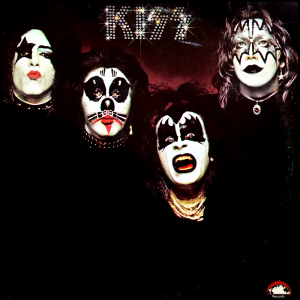
Kiss was formed in homage of the New York Dolls by Paul Stanley and Gene Simmons, two New Yorkers who had recently dissolved their previous band. They answered an advertisement by drummer Peter Criss and played a few shows as a power trio. Needing a lead guitarist, the band recruited Ace Frehley to complete the quartet. Frehley also designed the band’s logo.
Kiss attempted a more androgynous glam look before settling on the iconic characters that made them famous. From the beginning, everything related to Kiss was designed to be bigger than life: the drum kit was raised ten feet with primitive hydraulics, cardboard boxes were painted black to resemble Marshall stacks, and the band wore six-inch platform shoes.
Although the Kiss brand eventually succumbed to its own excess, during the band’s formative years there was something oddly appealing about their image and stage show. Previous rock acts had worn makeup and even explored pyrotechnics; The Crazy World of Arthur Brown actually beat them to it by seven years. The band’s presentation combined with their music, however, must have rendered early Kiss into a spectacle that audiences found both thrilling and threatening.
My copy of Kiss was gifted to me by my friend Tegler in 1992. We had visited a Baltimore tavern somewhere in Fells Point a week before, mocking a drunk idiot from Johns Hopkins as he attempted to have a conversation with two women at the end of the bar. For some reason, we all started talking about Gene Simmons before Hopkins Guy passed out. Tegler bought me the album a few days later, part joke and part remembrance, and it remains in my possession today.
Tracks
Side one begins with “Strutter,” a reasonably competent rock song with a decent melody and lyrics that evince cock-and-balls masochism. (These dudes weren’t exactly Mensa candidates in the words department back then). Musically, the song has roughly the same riff as “Gimme Three Steps” by Lynyrd Skynyrd. In fact, pretty much every song on this album resembles a trope by a better skilled band: Bad Company, Little Feat, Free, Deep Purple, even the Doobie Brothers. I do like Paul Stanley’s vocals, and Ace Frehley proves himself to be a strong lead guitarist. If Jimmy Page was, say, Pablo Picasso, then Ace Frehley was Jackson Pollock.
“Nothin’ to Lose” begins with an intriguingly sinister riff before launching into a weird, unexpected boogie-woogie stompfest. Gene Simmons takes the microphone this time, singing a charming tale about his baby’s “back door” and how “She didn’t want to do it / But she did anyway” (hardy har har). Subtle, Gene Simmons is not. I actually don’t find the lyrics as offensive as the music, which endlessly repeats the chorus “you got got nothin’ to lose” while Peter Criss camps it up in the background like he’s doing a parody of a bar band. The cheesy piano rolls are also a bit much.
Many fans consider “Firehouse” to be a Kiss classic, but I find the song’s tempo a bit plodding and its melody nonexistent. Frehley’s solo is pretty good, demonstrating some innovative techniques that became common vernacular among heavy metal guitarists a decade later. Sung by Stanley, the lyrics seem especially confused: “She’s like bad weather, but it seems so good / You’d never leave her, but you know you should.” What?
“Cold Gin” steps up their game. The tempo still plods, the melody is still missing, but at least there’s a driving riff to propel the song forward. “My heater’s broke and I’m so tired,” sings Simmons. “I need some fuel to build a fire.” This is Kiss doing “All Right Now” by Free with even dumber lyrics, but it’s agreeable enough. If you like your rock and roll crunchy with a steady thump, this song will slot very nicely along with all the bands whose riffs were shamelessly pilfered by Kiss to make this album.
“Let Me Know” brings back the bar band aesthetic to close side one. Again, it’s Frehley who steals the show with an inventive solo. He doesn’t simply scatter notes like electric confetti; there is genuine artistry in how he melds lyricism with feral rock power. The lyrics? Pawty awl nite!
Side two begins with “Kissin’ Time,” which was not included on the original track listing. According to legend, Casablanca Records founder Neil Bogart ordered the band back into the studio to record the song, which was a Top 20 hit for Bobby Rydell in 1959. It was released as a single but did not chart well. It did, however, boost sales of the album despite being added against the wishes of the band. I’m with the band on this one.
Fortunately, that travesty is followed by “Deuce.” Boasting one of the band’s best riffs and stupid-good rock lyrics (the opening line “Get up and get your grandma outta here” always cracks me up), the song became a Kiss concert staple for the next five decades. The band wisely follows a winning formula of letting the riff do all the work, allowing Frehley plenty of space to blister the studio walls with his Les Paul. I read somewhere that a great rock song requires a killer riff, and “Deuce” is great rock song with a killer riff. The best moment on Kiss.
The instrumental “Love Theme From Kiss” is a strange one. I couldn’t help thinking of the Byrds while listening to the track, wondering what it would sound like played on Rickenbacker 12-string guitars. Maybe we don’t want to know.
“100,000 Years” has another killer riff, bringing all the menace and excitement that justifies the band’s clownish appearance. Frehley’s solo is exceptional, and I really love the arpeggios he plays during the song’s descending bass part. The drumming feels a bit weak, though. Maybe it’s the way the drums were recorded, or something to do with 1970s recording technology. I wish Criss was more like Charlie Watts and strengthened the pocket with a solid groove, rather than flailing all over his kit with aimless pitter-pattering.
The album closes with “Black Diamond,” another Kiss classic that has been covered by numerous bands. I think I prefer the Replacements’ version of this song, in fact, although that again might be due to how the Kiss version is recorded. Criss takes a turn on lead vocals and does a credible job. The lyrics even make a sincere, if clumsy, stab at social commentary. The only bummer with “Black Diamond” is how the track ends. After Frehley’s solo, the band repeats a single chord while the tape slows down for nearly two minutes. The effect is…well, it’s a bit weird. I would have preferred that they spent those two minutes extending “Deuce” by another eight bars, but that’s just me.
Aftermath
Kiss increased in popularity for the remainder of the decade, their costumes getting sillier with each new album. By the time Dynasty was released in 1979, the band was performing flaccid disco tunes resembling a Las Vegas revue. With the Kiss brand now encompassing clothing, board games, action figures, lunchboxes, and comic books, the demographic of their audience skewed younger and younger. All the swagger and menace was gone. Gene Simmons’ “demon” persona was now about as threatening as H.R. Pufnstuf.
Peter Criss and Ace Frehley quit and/or were fired, depending on whose authorized biography one chooses to believe. With two new members in tow, Kiss finally removed the makeup in 1983. Although their musicianship had much improved by the mid-1980s, I might argue that Kiss were even more ridiculous trying to compete with flashy “hair metal” bands like Mötley Crüe, Poison, Ratt, and Cinderella. Eventually the original members put the makeup back on and embarked on a reunion tour.
Kiss ceased operations as a touring and recording entity in 2025, the same year Ace Frehley sadly passed away after a suffering a traumatic brain injury. Kiss performed their last show at Madison Square Garden in New York City. As of this writing, plans are to keep the Kiss brand viable in the form of oversized digital avatars. For a band who was always larger than life and more than its music, that seems about right.
Reply