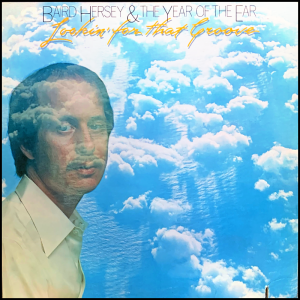
Baird Hersey and The Year of the Ear
No one is quite certain why guitarist and composer Baird Hersey selected The Year of the Ear as a moniker for the band he assembled in the mid-1970s. Maybe he found inspiration in Al Stewart’s album The Year of the Cat, released during that same time period.
It’s also possible that Hersey was influenced by the twelve Chinese Zodiac signs, which thematically assign each year to a different animal. We have the Year of the Ox, Rabbit, Tiger, Snake, Horse, and Goat, among others. Then again, by that logic we should have a year dedicated to eleven other semiotics of human anatomy. Why not a Year of the Tooth, for example, or a Year of the Spleen?
In any event, we have the recorded output of The Year of the Ear preserved for all eternity, and for whatever reason I happen to own a copy of their debut album, Lookin’ for That Groove. I tried to enjoy this weird blend of avant-jazz-funk-rock-fusion that defies categorization. Honestly, I really did. The band is talented and Hersey is clearly a skilled and intelligent composer. Unfortunately, I find parts of the album unlistenable to the point of cringe, and a few moments made me openly wince.
Background
Guitarist and composer Baird Hersey arrived in Boston in 1974. He studied ethnomusicology at Wesleyan University and music composition at Bennington College. He then led a blue-rock band called Swampgas, where his guitar playing reflected the influences of Duane Allman and Jimi Hendrix. Hersey’s artistic vision was not to be shackled to playing generic bar-band rock songs, alas, so he assembled an expansive collective of jazz-fusion musicians that ultimately comprised The Year of the Ear.
Favorably compared to Weather Report, (electric) Miles Davis, and the Average White Band, The Year of the Ear created sounds that were more atonal and adventurous than your typical fusion group. The band definitely had chops. Saxophonist Stan Strickland and trumpeter Mark Harvey played with the Aardvark Jazz Orchestra, and several other members were noted first-call session musicians in New York and Boston. Bassist Ernesto Provencher was a well-regarded music theorist and educator, and drummer Tommy Campbell’s resume included stints with legends Kevin Eubanks, Dizzy Gillespie, and John McLaughlin. In addition to writing and arranging nearly all the compositions, Hersey played rhythm and lead guitar.
Thus assembled, this collective of fourteen (!) musicians settled into Columbia Recording Studio in May 1977 to record what became Lookin’ For That Groove. The album’s liner notes credit a staggering volume of wind instruments. Tenor and soprano saxophones, flutes, trombones, trumpets, flugelhorns—if you enjoy the sound of brass being pushed beyond its physical capabilities, you’ll find something to like in this album. There is no questioning the physical stamina required to perform this genre of music, and the overall commitment to Hersey’s artistry is commendable. To these ears, however, the output works better when the band applies its maelstrom of labrosones more judiciously than a full-press assault.
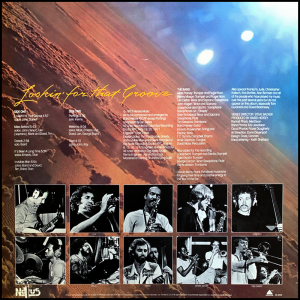
Tracks
Lookin’ For That Groove opens with its title cut. We get about a minute of strangely subdued noises that sound like game calls and exotic percussion, accompanied by some graceful guitar chords. The horns make their entrance with an appealing staccato rhythm, and it’s all quite agreeable. Everything breaks down at the two-minute mark, when the game calls return before we are treated to another few bars of space funk horns. My favorite part is when Hersey unleashes a filthy guitar solo that feels very much of its time. This track sounds like the theme song of a 1970s television show about two cops who only pretend to like each other. That’s a compliment, by the way.
“Miles Behind” has an annoying stop-start rhythm, some heavily treated funky bass, and an intricate horn arrangement recorded with too much reverb. The brass section seems to be exceedingly confused as to which horns should be playing which charts, and then they go all Ornette Coleman around the three-minute mark with random bursts of throaty drones. Although I enjoyed the overall premise, I must confess to stifling a juvenile chuckle at some of the deeper horn parts—the phrase “robots farting in unison” comes to mind.
“Greedy” pushes the funk levers all the way up. It’s three minutes of fun that really sounds like the theme song of a 1970s television show. The band plays it relatively straight, and Hersey’s guitar solo near the end is a tasty delight. The Year of the Ear is a much more appealing proposition when they keep things simple.
The mellow “It’s Been a Long Time” provides a welcome respite from the funk workout of the previous three tracks. I quite enjoy the off-kilter intonation of the horns this time around, demonstrating that dissonance has its place. Campbell’s drumming is exquisitely restrained.
“Invisible Man” is six minutes of what sounds like a rote jazz-funk band trying to be avant-garde. Although I admire the attempt, there is a point at which music intended to be challenging risks devolving into a cluttered mess. Sick-cow bleating horns, sloppy guitar playing, and overzealous drumming make this track an excruciating chore. And before anyone accuses me of being a philistine, let me say in my defense that I enjoy difficult music. I have happily and repeatedly listened to recordings by John Zorn, Einstürzende Neubauten, Fred Frith, Diamanda Galás, Renaldo & the Loaf, Eugene Chadbourne, and the Boredoms. I own nine Zoviet France albums, for flippin’ sake. Thus ends side one.
“Partings” brings back the mellow. With its extended intro of bongos, guitar, and relatively low-key horns, the nearly nine-minute track takes its time lookin’ for that groove. When the band eventually finds something resembling it, they lock into a fairly straightforward blend of futuristic jazz-funk-fusion. The trumpet (or maybe flugelhorn?) solo is nice, and the accompanying horns remind me of waves lapping against the walls of a jetty. The track closes with the same ambience as the intro the title track, strange reed noises and tinkles of percussion, only this time the effect is a bit more mysterious and subdued. As an example of what might be called “progressive jazz,” this one works pretty well.
Not so much the eight-minute “Melisma,” which defies patience from its opening notes. The band spends the first three-and-a-half minutes testing the endurance of both performer and audience, then the track weirdly accelerates to something that sounds almost bebop. Everything stops at the six-minute mark, at which point Hersey decides to unleash an inappropriate guitar solo that would sound more at home on a Thin Lizzy song. Actually, I would like to hear The Year of the Ear cover “Jailbreak.” That would be a lot more fun.
If you haven’t bailed out by now, I suspect you might upon hearing the album’s closing number “Tibet.” The screaming horns with no structure or harmonic correlation are simply too much for these sensitive ears to handle. The discordant cacophony of reeds brings Lookin’ For That Groove to a merciful end, having failed at its titular mission. It would have been more accurate to name the album Lookin’ For Those Earplugs.
Reply