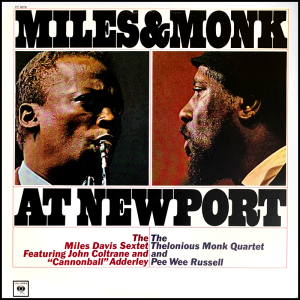
Miles Davis Sextet & Thelonious Monk Quartet
Recordings of jazz concerts present inherent challenges. There is always the risk of an extended version of some jazz standard exceeding the fifteen-minute mark, featuring an endurance-defying upright bass solo or sleazy chatter between performer and audience. The technical virtuosity required of jazz instrumentalists is frankly lost on the general population; hence the occasional dismissive tone that some might take when confronted with a live album from the genre.
Alternatively, live jazz recordings provide glimpses of the spontaneous magic that drives improvisation. For jazz legends like Thelonious Monk and Miles Davis, a live album is the next best thing to being in the room during their creative process. Miles & Monk at Newport, which captures two distinct sets recorded fives years apart, reveals both artists playing at peak velocity with their respective ensembles. It also represents an interesting connection between Monk’s dissonant, angular compositions and Davis’ Kind of Blue hard bop era.
Background
Miles & Monk at Newport is what was once called a “split album,” each side of vinyl featuring a separate performance by one of two artists. Side one is devoted to the Miles Davis sextet at the Newport Jazz Festival in 1958, while side two features the Thelonious Monk quartet at the same event in 1963. The two artists do not perform together at either date, although Davis’s set does include the Monk classic “Straight, No Chaser.”
The recordings in Newport capture both Davis and Monk at pivotal moments in their respective careers. Davis had just released Milestones with his first great quintet, expanded to a sextet with the addition of alto saxophone legend Cannonball Adderley. That album represented Davis’ first experiment with modal scale patterns. A month before his Newport appearance, Monk had released his first album for Columbia Records entitled Monk’s Dream. He would appear on the cover of Time Magazine a few months later, eventually becoming the second-most recorded jazz composer after Duke Ellington.
The Davis side of Miles & Monk at Newport is a setlist of four high energy numbers. At the time of its release, the album represented the only legitimate, non-bootleg recordings of this particular ensemble performing these compositions. The sextet reads like a “who’s who” of jazz royalty: along with Adderley, the group includes John Coltrane on tenor saxophone, Bill Evans on piano, Paul Chambers on bass, and Jimmy Cobb on drums.
The Monk side is more exploratory, containing only two tracks that each stretch well past the ten-minute threshold. As is typical with Monk’s compositional style, each piece features dissonant chordal structures and unexpected melodic interplay between the instruments. The great Charlie Rouse plays tenor saxophone, along with Butch Warren on bass and Frankie Dunlop on drums. Fellow improviser Pee Wee Russell appears spontaneously on clarinet (more on that later).
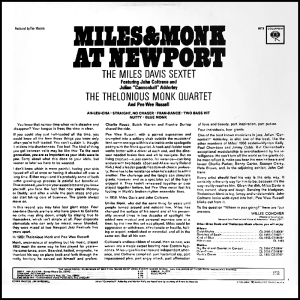
Tracks
Side one begins with Cobb counting in to open “Ah-Leu-Cha,” a brisk number that explodes out of the gate with interwoven brass and several tasty drum fills. The beauty of a Miles Davis solo is in his ability to demonstrate a kaleidoscope of tonal moods, from melancholy to affectionate to ornamental. This is Miles at his most animated, bursts of microcosmic energy matched by the saxophone duet of Coltrane and Adderley. Cobb’s drumming is spectacular throughout, especially his embellishes on the kick drum. His solo to close the piece builds to an abrupt stop, the audience momentarily stunned at what they’ve just heard.
That’s followed by the Monk composition “Straight, No Chaser.” There’s a fun bit about a minute into the piece, where pianist Evans plays an enigmatic little stop-start rhythm while the band keeps going. His solo after six minutes transcends the Monk aesthetic, all broken melodies and weird time signatures, before an obligatory bass solo by Chambers closes things out. Before that, though, we get a pair of transcendent saxophone solos: the exploratory, almost aggressive tones of Coltrane along with Adderley’s relatively smoother, bop-influenced mannerisms. The sound quality is excellent; you can hear Miles audibly stomping his foot to drive the tempo, and somebody sneezes around the eight-minute mark. Can’t get much more authentic than that.
“Fran-Dance” features Miles the suave charmer. His playing is smooth, maybe almost too smooth, yet it demonstrates the same yearning for nostalgia that haunts us all. The sax solos that follow provide an interesting contrast: Adderley’s subtle trills paired with Coltrane the sonic adventurer. Chambers’ playing is also exceptional on this track, sympathetic and supportive to what’s happening in front of him.
The peppy “Two Bass Hit” closes side one, with more wonderful drumming by Cobbs. The final minute is a tour de force for the entire ensemble, especially near the end, but Cobbs steals the show with a propulsive fury. You can almost feel the heat of the bodies on the Newport stage, the humid air pungent with the scent of nicotine and perspiration.
The Monk side opens with “Nutty,” the first of two very long tracks. Monk’s compositions typically feature strange dissonances and angular, odd melodies. Although Monk often employed modal twists, flat notes, and unexpected chromatic combinations. “Nutty” is a relatively straightforward tune that largely showcases Rouse on saxophone and Dunlop on drums. The four-minute mark is where is where clarinetist Pee Wee Russell enters somewhat infamously. According to some accounts, Russell was scheduled to rehearse with the Monk Quartet before their Newport set, only Monk didn’t show up for the session. This reportedly left Russell deeply apprehensive about the set, and this might explain why his appearance has been viewed as idiosyncratic. Russell does seem to peak a bit early before meandering through the rest of his solo. As I am not a legendary jazz musician, however, I have no business passing judgement. I can say the piano solo that follows is classic Monk, and I love the little stabbing clusters he drops during Warren’s bass solo to close the piece.
It’s at this point where I feel I must make mention of Monk’s list of rules, delivered to saxophonist Steve Lacy when he joined Monk’s band in 1960. Among the items were such nuggets as “stop playing all that bullshit,” “sing the melody in your head,” and “don’t play the piano part, I’m playing that.”
This is relevant to the album’s closing track, “Blue Monk,” which Monk’s piano opens like a drunk actor walking onto the set of a surrealist film. I love how Monk deconstructs his playing while Rouse delivers a top-notch saxophone solo, almost as if he is consciously allowing Rouse to explore the outer boundaries of the melodic landscape. When it’s Russell’s turn to solo, Monk builds an impromptu staircase chord structure during the first few tentative notes on clarinet. Perhaps Monk was sensing Russell’s discomfort, or maybe he was following his own advice (“don’t listen to me, I’m supposed to be accompanying you”). Whatever they did works, in any event, and the two interplay wonderfully; a slight chuckle from Monk can be heard at an especially scrumptious moment. At about the eight-minute mark, Warren and Dunlop are left alone to reinterpret the composition’s primary melody. Warren plays it straight at first, then reconstructs it down to the core. At some unspoken cue, the entire band joins in what sounds like a celebratory moment. As Monk advised Steve Lacy, “Always leave them wanting more.”
Aftermath
Following his appearance at Newport, Davis formed a second quintet with a much younger ensemble of talent, including 23-year-old Herbie Hancock on piano and a teenage drummer named Tony Williams. A series of medical and financial debacles, including bouts with substance abuse, coincided with Davis’ disregard of the more formal and melodic aspects of jazz. In its stead, Davis favored a more improvisational and less structured approach. Exotic and electric instrumentation became increasingly prominent, and Filles d Lilimanjaro is a personal favorite of mine from this phase. A decade of transition led to Davis’ “fusion” period, highlighted by the seminal releases In a Silent Way and Bitches Brew. Davis continued to perform and record for the balance of his life. Battling multiple health issues and rumors of HIV, Miles Davis passed away in a Santa Monica hospital in 1991.
Monk continued to record studio albums for Columbia, most notably Monk and Underground, and he maintained his quartet with Rouse while employing a rotating cast of bassists and drummers. After several years of relative stability, Monk disbanded his quartet following a 1968 performance at Palo Alto High School. Monk released a few more live recordings before disappearing from public view in the 1970s. His behavior grew increasingly erratic, featuring bouts of extreme agitation interspersed with long periods of self-isolation. He spoke to few people other than his wife and his medical caregiver, both of whom looked after Monk during the final years of his life. He passed away in 1982 in New Jersey. Live albums of the legendary performer continue to be released posthumously, including the 2020 release of that aforementioned Palo Alto concert.
Miles & Monk at Newport is not what I would call an essential document of either artist’s career; to these ears, both Davis and Monk released classic studio works that fulfill that expectation. Miles & Monk at Newport operates as more of an artifact, rather, offering an opportunity to hear Miles, Monk, Russell, Coltrane, Rouse, and Adderley weave their magic on a single slab of vinyl. The drumming of Cobb and Dunlop particularly stand out. And as with all live recordings of jazz musicians, the album’s delights are unearthed in the form of discovered juxtapositions and stellar virtuosity among individual players.
Reply