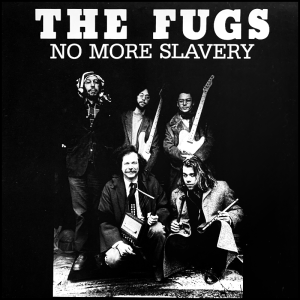
The Fugs
I knew Ed Sanders as a writer before I ever heard the Fugs. When I was in art school, my literature instructor Joe Cardarelli introduced me to Sanders’ anthology Thirsting for Peace in a Raging Century: Selected Poems 1961–1985. I devoured every poem in that book, fascinated by the concept of language as a creative instrument possessing visual, linguistic, and acoustic properties. Sanders was a regular visitor to Baltimore as part of the art school’s lecture series, where he performed his works accompanied by a handmade lyre and musical necktie. Signed copies of Sanders’ books Thirsting for Peace and Tales of Beatnik Glory proudly reside in my library.
I was somewhat less familiar with the writing of Tuli Kupferberg. I knew he was part of the same beat-to-hippie bridge as was Sanders, and together (with fellow poet Allen Ginsburg) they served as a sort of literary portal to the counterculture movement of the 1960s. Myself being a product of the late 1970s and early-to-mid 1980s, at the time I judged all that anti-establishment Woodstock-era hullabaloo to be bit quaint. In these egregiously uncertain times, however, I find myself hearkening back to the satirical wisdom of decades past. Kupferberg’s personage as writer and cartoonist was aptly described by his daughter Samara (a fellow student at the art school) as “a snarky anarchist version of Mister Rogers.”
Background
Together with drummer Ken Weaver, Sanders and Kupferberg formed the Fugs in 1964 to musically embody a marriage of three Bs: Beat poetry, the Beatles, and (Lenny) Bruce. The Fugs were an important part of the 1960s New York City underground scene, derided for their scatological lyrics and vulgar disregard for anything considered mainstream. At the same time, the Fugs’ anti-war political messaging was considered sufficiently acute to warrant the Federal Bureau of Investigation keeping a file on the group’s activities.
The Fugs released several albums during the 1960s, operating as a cottage media outlet combining musical performance with Sanders’ self-published poetry leaflets. Many of their songs attracted criticism for their thinly veiled sexuality, blatant celebration of narcotics, and accused references to Satanism. They toured Europe twice (including support slots with Fleetwood Mac, Tangerine Dream, and The Nice) before they ceased recording in 1969. Sanders and Kupferberg reformed the Fugs in 1984, featuring a new set of musical collaborators and a relatively more benign lyrical sensibility. This review catches the Fugs at the dawn of their second act.
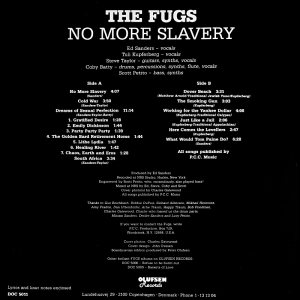
Compared to the Fugs’ early records (which were likely recorded in somebody’s basement and sound like it), many of the album’s tracks have a familiar 1980s sheen about them. Synthesizers, drum machines, and other technological gadgets contribute to the lineup of Steve Taylor on guitar, Coby Batty on drums, and Scott Petito on bass. Sanders and Kupferberg are listed as lead vocalists, although Sanders does the bulk of the singing, and all members contribute backing vocals.
I bought my copy of No More Slavery at one of Sanders’ Baltimore readings in the early 1990s. At the time, I remember thinking that it was much more interesting as a piece of writing than a listening experience. The playing is fine, if a bit pedestrian in parts. Taken on its own merits, at least to these ears, No More Slavery is more compelling as a cultural and literary document than a musical work. That’s the Fugs.
Tracks
No More Slavery presents a somewhat more palatable version of the Fugs’ lyrical themes, compared to such early gross-outs as “Group Grope” and (ahem) “Boobs a Lot.” The political anger is still there, however, albeit conveyed with more subtlety and updated for the Reagan era in which it was conceived.
The album begins with its title track, “No More Slavery,” a beautifully gentle song featuring acoustic guitar, strings, and pastoral flute (played by Batty). The lyrics reference Keats, Hampstead Heath, romantic desire, and what happens to aging poets when they pass their sell-by date: “I hope we’ll find a measure of peace / in the Golden Bard Retirement Home / I’ll be there / In a golden wheeled chair / a-wheelin’ with you my love.” Those familiar with Fugs albums of the 1960s might be a bit startled by the lack of free-form shouting. It warrants mentioning that Sanders has a lovely singing voice, however, and the accompanying vocal harmonies are exquisite.
That’s followed by “Cold War,” which is very much a product of the 1980s in both concept and execution. Featuring a robotic beat with an insistent bass line, it sounds almost like a Cars outtake. The song’s lyrics reference domestic strife as a metaphor for strained relations between countries, in this case the United States and Russia. Given the time period in which it was recorded, I’m not sure the song has dated all that well. There’s a funny spoken bit at the end about hiring workers to build pyramids.
Nearly the rest of side one is devoted to the eleven-minute, seven-part “Dreams of Sexual Perfection.” This is about as close as No More Slavery gets to rekindling the anarchic, erotically depraved vibe the Fugs were known to embrace in their 1960s incarnation, bursting out of the gate with this couplet: “He made love with a sheep / In 1969 / She slept with a girl / Inside a ball of twine.” (This is the point of the review where I should mention that Sanders has written poems about having sex with not only sheep, but also trees and mythological entities. Context is important). The lines are delivered with comedic edginess against a raucous guitar riff, and I’m reminded of Joe’s Garage by Frank Zappa. We are then treated to an acoustic folk melody that serves as the piece’s recurrent motif, accompanied by placidly sung lyrics describing Emily Dickinson as a repressed nymphomaniac: “Sweet, sweet Emily / The bees buzz ’round your fingers / Spread wide your limber limbs / And let your lover in.” Following this interlude, the band explodes into a frat boy chorus of “Party! Party! Party party party!” I always laugh at this part because it’s genuinely funny, and you will too if you choose not to take the lyrics too seriously. If you’re the sort of pilgrim who gets all red in the face at the word “breast,” then maybe skip this one. Be aware, however, that “Dreams of Sexual Perfection” is the best track on the album and perfectly encapsulates the 1980s version of the Fugs.
Side one closes with “South Africa,” a faux reggae song with a catchy chorus and lyrics that scorn racial segregation in the song’s namesake country. Listening to the track just now, I was struck by the following lines: “Oh South Africa, come to your senses / Your ship is on fire/ There’ll come a day/ When the ship of Apartheid / Shall sink in the bay.” I wonder if the lyrics reference the Clotilda, the last known slave ship to arrive in the United States some fifty years after slavery was abolished. According to history, Captain William Foster captured members of African tribes and brought them to Alabama in 1860, skulking into Mobile Bay under the cover of night. Once all captives on board had been sold, Foster then ordered the Clotilda to be taken upstream and destroyed to conceal the evidence of their illegal activity. Deep stuff for what on surface is a reasonably light, three-minute pop-reggae dance track.
Flipping the record over, side two starts with Kupferberg reciting the opening stanza of “Dover Beach.” Based on the poem by Matthew Arnold and re-recorded from the Fugs’ 1968 album Tenderness Junction, this version trades woozy electric psychedelia for acoustic folk mysticism. The musical necktie makes an appearance (I believe), adding to the song’s warmth and mystery. A wonderful rendition of a Fugs classic.
“Smoking Gun” is another 1980s-styled Cars outtake, with a better groove and a terrific snarly vocal by Kupferberg. I love the little guitar figures against the synth horns. I’m not certain if the lyrics are defending the tobacco industry, or whether smoking serves as some sort of literary metaphor (perhaps symbolizing the people’s fight against The Man, or whatever). Great track, though. Mission of Burma should have covered it.
The goofy “Working for the Yankee Dollar” puts Kupferberg’s lyrics about the automobile industry against a traditional Calypso tune: “They work up, up in Michigan / They blame us, well you can wish again / Capitals goes where the profits be / And they couldn’t care less if they screw you or me.” Kupferberg’s faux Jamaican accent is either humorous or cringe-worthy, depending on your particular viewpoint. I’m somewhere in the middle.
“Just Like a Jail” is an anti-war a cappella tune sung by Sanders, followed by a spoken word intro by Kupferberg which leads into “Here Come the Levellers.” Lyrically, it stands up well to the usual themes explored by the Fugs. Musically, it’s a fairly uninteresting rock song played to a marching beat. The words are what matters in both these pieces.
As is the case with album closer “What Would Tom Paine Do?” The musical accompaniment is there to support the lyrics, which have not dated especially well (“I want to be a pamphleteer / In the name of Tom Paine’s ‘Rights of Man’ / But what is the name of the pamphlet / In the age of laser discs and satellite time?”). The chorus “Protest and survive” gets a bit hokey as well, although I would forgive these excesses if the track didn’t run over six minutes in length.
Aftermath
The Fugs released four more albums between 1987 and 2023, the most recent being Dancing on the Universe. Tuli Kupferberg tragically passed away in 2010. The 1980s version of the band occasionally reforms for festival appearances in and around New York City, and their classic songs (most notably “CIA Man” and “Kill For Peace”) can be heard in contemporary films and television shows.
Ultimately, the appeal of the Fugs remains their Dadaist pursuit of hedonistic pleasure and civil liberty. My instructor Joe Cardarelli used to parallel Ed Sanders’ writing with that of the classic Greek poet Archilochus, who composed works celebrating the self as an instrument of emotional and physical significance. This might explain why Sanders dedicated the poem “Hymn to Archilocus” in Thirsting for Peace to Cardarelli, perhaps reflecting their shared passion for language and art as ephemeral human needs:
O bards
ponder Archilocus
you who think,
“Hey, my poems are going to last
all the way till the Milky Way
explodes.”Your archives
bulging in acid-free binders
at U.C.-San Diegoand a staff
of graduate students
sorting them clean!
Reply