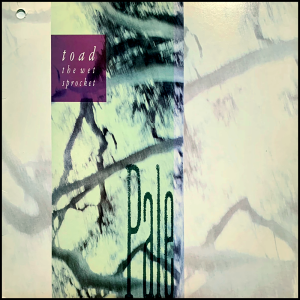
Toad the Wet Sprocket
August 1991 was a strange period in my life. Just three months earlier, I had delivered the commencement address at my college graduation. It now felt as if every construct of dependency had simply ceased to exist: my then-girlfriend/now-wife was in Greece for the summer, I had completed a lame-ass internship with no prospects, and everyone else I knew had either moved away or secured proper jobs. Broke, unemployed, lonely, and depressed is no way to go through summer—the heat and humidity imbue a sense of foreboding that suffocates the soul. It probably didn’t help that I was listening to a lot of Tom Waits at the time.
As summer faded into fall, my friend The Patness gave me a tape of Toad the Wet Sprocket’s debut album Bread & Circus. It featured lots of strummy guitars and some nice vocal harmonies on otherwise meh songs. The Patness raved about Toad; I thought they were okay. Besides my general distrust of pop bands from southern California, I thought Toad had a stupid name (their moniker is lifted from a Monty Python sketch). And anyway, if I wanted to hear a better version of R.E.M., I already had Miracle Legion within easy grasp.
Sometime in October 1991, The Patness and I were at his house when he played Toad’s third album Fear. It had a few nice moments, with much improved delivery in both style and substance. We learned Toad would be playing an acoustic set at the local record store, so a bunch of us climbed into my rusted 1983 Toyota Corolla to go check them out. “I had no idea they were this popular,” gasped The Patness upon seeing the shop packed wall-to-wall with eager Toad fans, all of them hoping to capture a glimpse of their whitebread heroes.
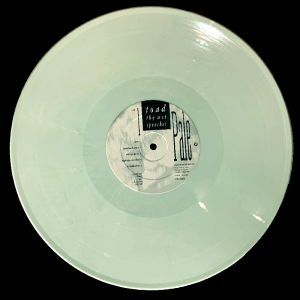
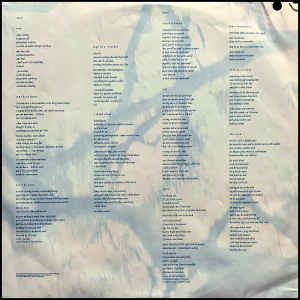
Perhaps I was feeding into my ongoing despondency, or maybe I felt that I was missing something that everyone else knew, but that week I purchased Toad’s second album Pale from the cutout bin. My milky-marbled 1990 vinyl pressing is now considered rare and known to fetch hundreds of dollars on Discogs and eBay. I wish I could declare the album’s audio content lives up to its Mylanta-colored glory, but I’ll get to that.
Background
Toad the Wet Sprocket formed in 1986 in the town of Santa Barbara. All of its members were nineteen years old, except for lead vocalist Glenn Phillips who was only fifteen at the time. In order join the band, Phillips needed to pass his California High School Proficiency Exam and graduate high school as a sophomore. This part of Toad’s backstory interests me much more than their silly name.
Pale was recorded independently for $6,000 USD. Any sarcastic remark you want to make about Santa Barbara’s per-capita household income in the late 1980s is solely discretionary. I’ll refrain from criticizing the intentions of teenagers who want to pursue their dreams; however, I look back today and wonder if my disconnect from Toad was partly driven by economics. If I had $6,000 lying around in 1991, me being roughly the same age as the members of Toad, I could have paid my rent for a year and maybe replaced the engine in my hoopty. But that’s just me.
Tracks
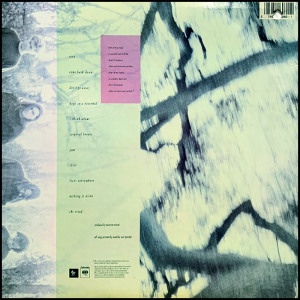
The album opens with “Torn” and the sound of a creaking door, merely the first of several 1990s rock band clichés that appear on Pale. A somber yet simple guitar line follows, accompanied by Phillips’ lead vocals that recall Michael Stipe at his least articulate. When he does enunciate, Phillips is resoundingly miserable: “I fear nothing / besides myself” reads the lyric sheet in all-lowercase italic. “I feel nothing / besides this pain.” I feel for the dude, but the music simply doesn’t elevate his words beyond adolescent poetry. There’s a beautiful moment after the second chorus where the band appears poised to reach a crescendo, but instead they scamper away like children caught with their hands in the cookie jar. An unsatisfying opener.
“Come Back Down” was one of the album’s singles, and compared to the majority of Pale it actually has a bit of a hook in the chorus. This is where it’s evident that the real hero of this band is bassist Dean Dinning, whose understated playing creates a bit of melody and suspense in mundane guitar-based songs. A touch of mandolin adds some ringy fake-folk color, another cliché among emotive 1990s bands, along with the “Hey Joe, could you spare a buck” lyrics. (God, I hate songs that start that way). Not a horrible track; merely inconsequential.
“Don’t Go Away” is four-and-a-half minutes of blah. Three tracks in, and Phillips’ voice is already starting to grate on me. The guest violin is buried in a cruddy mix, and I have this deeply intrinsic hankering to hear “Thunderstruck” by AC/DC at full volume.
From the title alone, one might anticipate “High On a Riverbed” to be a bit more upbeat. Nope. Whereas Iggy Pop growled, “So messed up / I want you here” with genuine empathy and menace, these cupcakes say stuff like “I see myself sometimes / Vision is a mystery half blind” and expect us to take them seriously.
“I Think About” begins with a relatively quicker pace before the band drags everything back down. For flippin’ sake, even a bit more spritely drumming would have saved this borefest from congealing into inertia. Dinning does his best with some decent bass lines, but by this point the entirety of Pale can be summed up in one lyric: “On and on and on …” Thus ends side one.
Side two begins with yet another slow build, but “Corporal Brown” offers a welcome twist: actual tension and release. The band effectively layers ascending guitar and bass patterns for nearly a full minute, which allows drummer Randy Guss to demonstrate his chops playing a number of tasty fills. When the entire band joins on the chorus, I go to pop ‘n fresh heaven as all those arpeggios cycle in polyrhythmic ecstasy. Even the lyrics up their game by avoiding the first-person singular, instead telling the story of some asshole who kills his wife while unknowingly being watched by a drunk neighbor. The background harmonies are exquisite, as Phillips sings “Oh lord, what am I gonna do?” from the view of his beer-goggled protagonist. At this point of the album, it’s easily the best moment on Pale. By a long shot.
“Jam” doesn’t quite hit that high, but the track gets credit for at least introducing a bit of distortion to the guitars and some needed drum propulsion. The band actually sounds like it’s working up a sweat this time. The lyrics return to vague sentiments like “Too long, too late this time.” Deep stuff, dudes. I know this song is popular among Toad fans, so I’ll reserve any further commentary.
“Chile” is a weird one. It returns to the slow pace evinced by much of Pale’s first side, yet everything seems a bit more amped up. There’s some accordion drones going on in the background, while Phillips sings “It’s hard to tell the right from the wrong” with all the depth and theatrical power he can muster.
“Liars Everywhere” accomplishes yet another 1990s cliché: the short, yet quirky, acoustic deep cut. For most bands, such tracks were typically buried as the fourth of six tracks on side two. In terms of tone and tempo, this song resembles nearly every other song on Pale. On an album featuring more sonic variety, and maybe more of a spine in general, this brief little number would be a welcome oasis. I can’t hate it, but it does nothing for me.
“Nothing Is Alone” begins with more strumming guitars, more heroic bass by Dinning, more competent drumming by Guss, more banal lyrics like “If the winter won’t turn me / Then the summer can’t burn me.” Just before I’m beaten down yet again by the earnestness of it all, the song weirdly transforms into a jaunty faux-Irish jig. Imagine a west coast version of the Pogues with fully-functional livers and zero authenticity, and you’ll get the idea.
“She Cried” opens quietly with Phillips whispering “Solitaire, such a fateful game / She turns her cards and writes her name on the napkin.” Jeez, since when did rock music turn into a movie plot for the Hallmark Channel? The verses meander for three minutes about some sort of incident with some sort of couple. Thankfully, Toad kicks it up a gear near the end. They won’t exactly remind you of Slayer, but as they do in “Corporal Brown” the band demonstrates an ability to build tension into something reasonably compelling. If you’re counting, that’s two pretty good moments out of nearly forty minutes of listening investment.
Aftermath
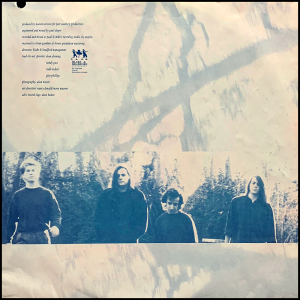
Toad the Wet Sprocket’s third album Fear became something of launchpad for the band, catapulting them to the status of MTV darlings for much of the next decade. They formally disbanded in 1998, sporadically reforming for the occasional performance or short tour. Minus their founding drummer, Toad resumed full-time operations in 2009 as a three-piece. Because Columbia Records owns the rights to Toad’s back catalogue, the remaining members recorded some of their older material for licensing purposes. It’s a smart move, and I admire any artist who takes control of their livelihood.
I am well aware that Toad fans outnumber cranky gits like me. Having seen the band perform live in October 1991, I can say there is some appeal to their winsome melodies and aw-shucks onstage charm. I recall they played in a tiny club heaving with bodies, and the songs they performed from Pale sounded much more energetic in person than the flaccid specimens they recorded. In the car ride home long after midnight, I heard The Patness softly singing “Come Back Down” from the backseat. It wasn’t a bad way to spend a Wednesday evening.
As for me, that very night marked a personal transition point. Upon arriving home in the wee hours, in fact, I found a message on my phone’s answering machine offering me my first real job. I could feel my mojo coming back, which not coincidentally aligned with a steady source of income and an obsession with albums released on independent labels. Thus began my noisy avant-garde phase, the lugubrious crawl of Pale discarded in favor of Tago Mago by Can, Legend by Henry Cow, and Naked City by John Zorn. Things were looking up.
Reply