Talking Heads
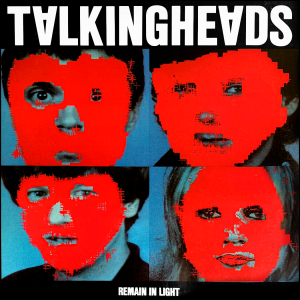
David Byrne and I share a birthday. Being a fellow Taurus, I might be expected to demonstrate empathy for the egregious quirks Byrne reportedly inflicted on his fellow members of Talking Heads. The truth is, I’ve long since tired of Byrne’s twitchy persona as observer of the mundane. All it takes to get my eyes rolling is yet another exclamation of David Byrne The Super Genius being inflicted on my weary brain.
That being said, Talking Heads produced some amazing music during their time together. Released in 1980, Remain In Light is considered the pinnacle of their creative powers. Along with London Calling by the Clash and Dirty Mind by Prince, you can pretty much guarantee that Remain In Light will appear in the top five of most critics’ lists for best album of that particular year, if not the entire decade.
To throw all the creative accolades at David Byrne, however, is inaccurate and unfair. Along with Byrne, drummer Chris Frantz and bassist Tina Weymouth attended the Rhode Island School of Design and boasted artistic chops of their own. Guitarist and keyboardist Jerry Harrison studied architecture and had a solid musical pedigree. In fact, there are many days where I would suggest that Talking Heads were a much more interesting band when they operated in an egalitarian fashion.
This is the point where I mention the contributions of producer and de facto fifth member Brian Eno, who brought a sense of sonic and thematic exploration that became intrinsic to Talking Heads’ best work. I’ve frankly always found their first album to be a bit of a snooze; things improved with More Songs About Buildings and Food, and Fear of Music remains a terrific front-to-back listen. In the latter’s opening track “I Zimbra,” you can hear the conceptual genesis of what became the foundation of Remain In Light.
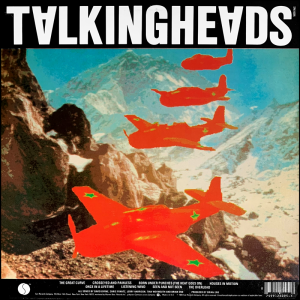
Background
By all accounts, this record shouldn’t even exist. The band were split into at least two camps: Byrne and Eno on one side, Weymouth and Frantz on the other. Clearly growing tired of Byrne’s emerging dominance, Weymouth and Frantz discussed starting a new project with guitarist Adrian Belew. The two ended up purchasing an apartment in the Bahamas above Compass Point Studios. Harrison joined them in Nassau after producing an album for singer Nona Hendryx, with Byrne and Eno arriving some time later.
The songs from Remain In Light took shape from long instrumental jams, similar to the polyrhythmic music of Nigerian legend Fela Kuti. This Afrocentric sensibility was always part of the band’s mindset, however, as both Weymouth and Frantz were keenly aware of the emergence of hip-hop and non-western influences on their musical world. Tracks were built around simple loops and transformed into compositions, their instrumental strains woven together into a rich tapestry of fascinating juxtapositions. Many of the album’s lyrics were reportedly influenced by the testimony of Watergate scandal conspirator John Dean, which made for a welcome (if odd) change from Byrne’s deadpan vocal delivery.
According to history, the band’s vision for the album was to have a “fast” side and a “slow” side. This is where I think Remain In Light suffers a bit, perhaps not quite achieving the lofty accolades I exclaimed when I first bought the album as a young lad. Side two in particular seems to degrade quickly, crawling almost to a stall until it closes on a true bummer. Maybe that was by design, but I’d be dishonest if I failed to mention that the running order stacks all the weakest material at the end of side two. This does not diminish the legacy of the album’s first four tracks as being arguably the band’s finest recorded work. World beat, dance rock, new wave … whatever the genre, the album’s highest peaks represent a slab of fine art that shakes your rump while flexing your brain.
Tracks
Remain In Light kicks off with “Born Under Punches (The Heat Goes On),” probably my favorite Talking Heads song. The intricate guitar playing and complex polyrhythms make it clear that the band was a long way from their humble beginnings as a boring (sorry) acoustic three-piece. Byrne’s vocals are in fine form, combining the lunatic mannerisms of a carnival barker and a Baptist minister, yelling things like, “Don’t you miss it! Some of you people just about missed it!” and “I’m a government man!” Weird noises skim the surface of the mix, building tension as the background vocals sweetly chant “And the heat goes on” as the song fades.
The next track is “Crosseyed and Painless,” the most ‘rock’ of any of the album’s tracks. It’s evident why this song became a live standard for the band: it has a groove that refuses to stop, and Byrne surprises everyone by channeling his inner Kurtis Blow during the closing rap. (The idea of someone like Byrne attempting to rap in any form is hilariously post-modern, especially appropriate for 1980).
“The Great Curve” keeps the party going with layers of syncopated percussion and strummy guitars, while Byrne informs us that “the world moves on a woman’s hips.” Guest musician Belew unloads a guitar solo that spreads electric butter over the whole thing, while guest vocalist Hendryx and others engage in a delicious call-and-response to wrap up side one.
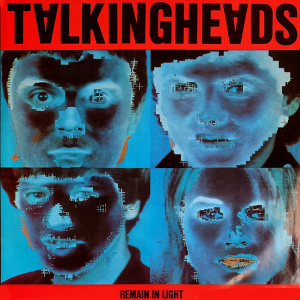
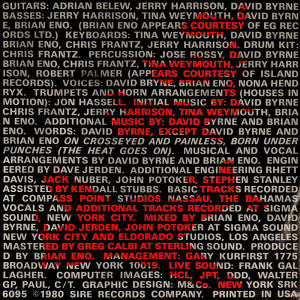
That’s three very long tracks on one side of vinyl, which leaves the funky “Once In a Lifetime” to open side two. This song still holds up as among the band’s finest works, with Weymouth delivering that classic badum-bum-bum, badum-bum-bum opening bass line amid wiggly synths. Everyone always references Byrne’s “you may ask yourself” lyrics, but to me the unheralded star of the show is Frantz on drums. Listen closely to this song and hear for yourself how difficult it is to stay in the pocket amid all those sonic distractions. Byrne is at his best here; I personally love when he tells us “there is water at the bottom of the ocean” and mutters “same as it ever was,” an actual chorus in a song that contains exactly two notes, one riff, and zero chord changes.
From that zenith, however, Remain In Light starts to drag a bit. “Houses In Motion” is pleasant enough, although I prefer the live recordings I’ve heard compared to the studio version. I wonder if the album overall would have been stronger had they let this track extend for a few minutes, then closed side two with another upbeat song. Byrne starts to sound tired here; his lyrics and delivery don’t have the same spark as do the earlier tracks. “Never get to say much, never get to talk,” he mumbles at one point. “Tell us a little bit, but not too much.” Whatever, David.
“Seen and Not Seen” is a weird little piece with synth whooshes, brisk handclaps, and Byrne deadpanning something about faces. It would have worked better for me as an instrumental. Interesting, but inconsequential.
“Listening Wind” builds up a nice atmosphere (I’m reminded of “History of the World” by Gang of Four), then does nothing at all with it. The chorus sounds particularly flat to these ears. Again, I’ll offer the controversial opinion that this piece may have worked better as an instrumental.
“The Overload” is where Remain In Light loses all momentum for me. It’s a six-minute dirge that reportedly was the band’s attempt to channel a Joy Division song, minus the tension and fidelity of Ian Curtis’ presence, and instead comes off as a parody of that group’s sound. It is a credit to Remain In Light that it is able to close on a relatively unhappy note, yet the album still validates its status as a classic based on half its contents.
Aftermath
Talking Heads cut ties with Eno after Remain In Light, committing their efforts entirely to the pursuit of booty-shaking on the subsequent Speaking In Tongues. After the release of Stop Making Sense, arguably the greatest concert film ever made, the band transitioned from boring pop to boring rock to boring salsa to venomous extinction.
The legacy of Remain In Light lives on. In 2018, Angélique Kidjo recorded and released her own track-by-track version of the album, elevating the original’s weaker material into wholly new realms of sonic innovation. Although it may be blasphemy to say this, in fact, I might even suggest that Kidjo’s interpretation is the better overall work. But don’t tell my birthday twin that.
Grade: B+ (8.2/10)
Reply