The Legendary Pink Dots
The first two minutes of David Lynch’s classic film Blue Velvet is a study in contrasts. The viewer is treated to a series of wholesome visuals, all shot in voluptuously saturated color: a deep blue sky, brilliant yellow and red roses in front of a gleaming white picket fence, the smiling visage of a firefighter waving from a freshly waxed fire engine, children happily skipping on their way to school. One can smell the freshly mowed grass being watered by the geriatric homeowner, his wife comfortably settled inside the domestic cocoon of their living room. That same man then collapses to the ground in severe pain, perhaps the result of a stroke or heart attack, as Bobby Vinton croons his signature title song in the background.
The camera then pans downward to the grass upon which the man is laying, deep into the recesses of the soil, revealing another realm of life that exists behind the happy facade of antiseptic suburban bliss. It’s a mysteriously dark, moist, and dangerous world, one populated by hostile insects who angrily claw at each other in an orgiastic fight for survival. The message is clear: things are not always what they seem, and every moment of tranquility contains a sinister undercurrent of subterranean horror beyond our casual knowledge.
Such is the experience of listening to The Legendary Pink Dots, an English-by-way-of-Amsterdam experimental band who have been producing avant-garde soundscapes since 1980. Over the course of their existence, the Dots have maintained a distinctive artistic vision that defies categorization. Despite their often being lumped with other practitioners in a genre some call “neo-psychedelia,” the Dots’ music also contains elements of acoustic folk, synth pop, post-punk, progressive rock, jazz, goth rock, electronic industrial, ambient, noise, and even baroque classical.
Although their records are always adventurous and occasionally excessive, the Dots’ output is never abrasive past the point of endurance. Much of their work is surprisingly accessible, in fact, with clear melodies and sensible song structures. Their lyrics, however, are like the underworld depicted in Blue Velvet’s opening sequence: dark and disturbing, foreshadowing a violently dystopian future on the brink of apocalypse.
Background
For much of their lengthy career, The Legendary Pink Dots have consisted of two core members: singer-composer and keyboardist Edward Ka-Spel and keyboardist Phil Knight (also known as The Silver Man). On their recordings and for live shows, the duo are often accompanied by a rotating cast of contributing members. Ka-Spel’s vocals somewhat resemble those of Syd Barrett, and similarities between the Dots’ albums and Barrett’s solo records are a fair comparison.
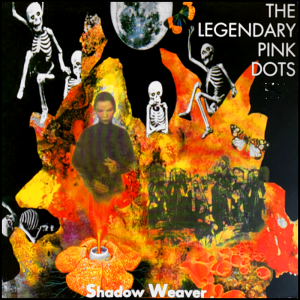
Shadow Weaver was released in 1992, following a series of elegant, goth-influenced releases that earned the phrase “difficult but rewarding.” To that point, the Dots’ albums had attracted favorable reviews from slightly confused critics. The Dots built a loyal cult following, however, especially in Europe; their preceding albums The Crushed Velvet Apocalypse and The Maria Dimension remain fan favorites. On the latter release, the Dots began to augment their mix of electronic and industrial sounds with Eastern influences and more traditional acoustic instruments. That exotic blend also emerges on Shadow Weaver, its swirling, pulsing soundscapes supporting Ka-Spel’s deadpan vocal delivery and grimly despondent lyrics.
I purchased my copy of Shadow Weaver while living in Baltimore in the early 1990s, the apex of my “weird music” phase. I tend to associate the album with my heavy consumption of John Zorn, Fred Frith/Massacre, Can, and Tuxedomoon during that period. My friend Tegler owned The Legendary Pink Box, an assortment of 24 tracks compiled on two compact discs. I remember feeling at the time that Shadow Weaver didn’t hold up to the best material from that compilation. Listening to the album again has softened my position, however, and there are wonderful moments to be found among its eight core tracks. It’s definitely weird but by no means unlistenable, and sometimes quite beautiful.
Tracks
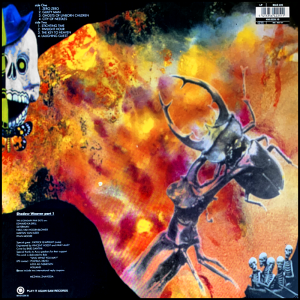
Shadow Weaver begins with the robotic electronic beat and throbbing bass of “Zero Zero,” a lengthy opener that introduces Ka-Spel’s disquieting vocals amidst a bed of piano, keyboards, and woodwinds. The Dots’ talent as sound artists is evident, with bursts of distorted guitar and hand percussion dancing in and out of the mix. Meanwhile, Ka-Spels’s urgently seethes “We checked out all the prophecies / We studied fat philosophies / We made a graph / We chanted ooooommmmm … Are you listening? / No chance.” My favorite bit comes at the end, where a lovely acoustic guitar is played in counterpoint with the main piano melody. The feeling conveyed is of lost expectation, a moment of anticipated enlightenment that ultimately proved to be nothing: zero zero, indeed.
“Guilty Man” brings to mind an industrial wasteland populated by sinister robots, perhaps a calmer Nine Inch Nails track. It’s not entirely clear to me whether the lyrics reference the song’s protagonist in a jail cell, or whether they describe the paranoid state of one’s mind: “All wired up with no-one to kick but myself in a cell and an ape with a stick who’s bigger than me and complains that he’s sick of my story.” Regardless of the song’s meaning, I love the little saxophone solo that appears in the middle of all these digital gizmos competing for attention. Ka-Spel’s yelping at the end amplifies the track’s queasiness factor.
“Ghosts of Unborn Children” is another calm-yet-disturbing piece, with placid organ and gentle wah-wah guitars framing cheerful sentiments such as “Did you hear me crying in the night that lasts forever? Did you see me reaching out from Never Never Land?” The track’s second half shifts abruptly to a demented Victorian or polka dance-hall beat. Solos played on soprano saxophone and electric guitar interweave, like two moths competing for attention from the same flickering light bulb. Very weird.
Those who suffer from misophobia might want to skip the first thirty seconds of “City of Needles,” which begins with a cluster of whispered vocals before another industrial landscape emerges from the fog of sibilance. This track showcases the Dots industrial tendencies, resembling the relatively more benign moments of Throbbing Gristle or Revolting Cocks. Meanwhile, Ka-Spel sneers glad tidings about being poked in the eyes with hot sticks by female serpents. Thus ends side one.
Side two begins with “Stitching Time,” an atmospheric piece performed almost entirely on ethnic acoustic instruments: violins, low-tuned guitars, and exotic percussion dominate the mix. It sounds a bit like what one might envision being played in a Turkish café. Who knows what Ka-Spel means when he sings, “I shed my disguise when there’s nobody looking. The whites of your eyes are all mine alone. And I’m written in stone. I’m the dust on your carpet. A guest in your home because that’s where the heart is.” The track makes a fascinating turn for the final minute, collapsing into near-ambient soundscape of distorted guitar whines and synth washes before closing with the sound of water splashing.
“Twilight Hour” seems to continue the journey from its preceding track, the synths eventually giving way to the bilious throaty roar of a didgeridoo. The lyrics are typically bleak (“this boat’s going to sink and we’re all gonna die” … jeez, dude), and we’re about at the point where I start to really wonder about our friend Ed. The soundscape the Dots create, however, is effective and compelling.
“The Key to Heaven” is like entering an insane carnival with H.P. Lovecraft as master of ceremonies. There are all sort of rumbling noises, barely-tuned organs, little blippy synths, more saxophones and woodwinds, and a bit of wah-wah guitar supporting what amounts to an actual chorus: “I think I’ve found the key to Heaven, but I cannot find the door.” My favorite bit occurs near the end, when everything explodes into cacophony like some sort of free-form jazz freakout. I remember putting this track on a mixtape for my uncle; let’s just say that decades of listening to Bad Company and the Doobie Brothers did not adequately prepare him for this.
The lengthy “Laughing Guest” closes side two, operating as an encapsulation of everything we’ve heard to this point without directly referencing any previous track. It’s at this point where the Dots’ genius in sound sculpture becomes evident; their use of space and distance rivals anything Pink Floyd did on their landmark album Dark Side of the Moon. It’s more a piece of audio art than song, although Ka-Spel does take a moment to reinforce the album’s lyrical themes of discouragement, fear, and antagonism: “Does my eye offend you? Should I roll it down the hill / Should I wear an iron mask or warn you with a bell?” The piece ends with the sound of synthetic machine-gun noises, voices screaming, and digital birds chirping, leaving the listener in silence to comprehend what exactly just happened.
My vinyl copy of Shadow Weaver only contains these eight core songs, but I must make mention of two bonus tracks added to the compact disc and digital download versions. “Prague Spring” is a lovely and surprisingly conventional neo-classical piece for strings, woodwinds, and piano that recalls the more lyrical work of minimalist composer Philip Glass. “Leper Colony” is six-plus minutes of creepy atmospherics, a sort of counterpoint to “Laughing Guest” that ends with a crescendo of cyclical saxophones and woodwinds: a slight detour of potential interest, but not essential.
Aftermath
Phi Knight (The Silver Man) retired from touring in 2022 and is not listed as contributing to any recordings since, leaving Edward Ka-Spel as the lone founding member. The Dots continue to tour as a four-piece, mostly around Europe, although they did travel to the United States as recently as 2019.
I couldn’t begin to tell you the best way to enter the Dots’ adventurous and prolific body of work. The Dots’ discography is absolutely massive; their Bandcamp site alone literally contains hundreds of releases, including solo albums by Ka-Spel and various side projects and live recordings. Many fans place The Maria Dimension and The Crushed Velvet Apocalypse as the band’s two best recordings, both of which were released during what most consider the duo’s most fruitful period of invention.
My best advice would be to simply pick an album the way one might enter an outdoor vendors’ market: stop at the first booth that interests you and see what’s there. You might go home with a curious souvenir that forever sits on your shelf, or you might develop a lifelong anthropological obsession. Both are equally plausible outcomes. One might argue that any Dots album issued between 1983 and 1997 can operate as an appropriate portal into the Dots’ strange, foreboding, and fascinating world. Have at it, kids.
Reply