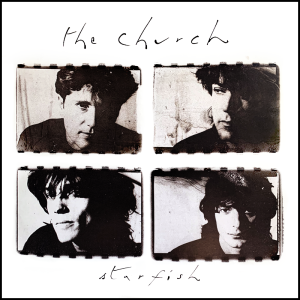
The Church
The summer before I left for college, I was having a conversation at a party with some dude I’d just met. We discussed bands we liked, as was the social custom among eighteen-year-olds during the 1980s.
He asked me if I’d ever heard of the Church. “That’s got to be the most stupid name for a band I’ve ever heard,” I silently growled to myself. We went into a room someplace and he pulled out his cassette tape of Heyday, the band’s most recent offering to that point. I expected the worst.
As the album’s lead track “Myyrh” kicked into gear, however, I found myself immediately drawn into the sound. It was aggressive but ornate, with chiming guitars and a solid bassline. What sold it for me were the world-weary speak-vocals of Steve Kilbey, who sang a bit like a less melodramatic Low-era David Bowie. The band’s lyrics were brilliantly arcane, if a bit clunky (“We’re interrupted by the telephone / We didn’t think they were invented then”), with occasionally maddening episodes of preciousness (“Ornamental and warm and gentle / All the way to paradise”).
Fast-forward to my freshman year at the art school. I was on the floor of the student housing apartment I shared with two roommates, working on some two-dimensional design project, when the radio announced that the Church had just released a new album. As the gentle chords of their soon-to-be-hit “Under the Milky Way” filled the room, I made a mental note to investigate further.
Background
The Church were formed from the remnants of various Australian bands based in Canberra and Sydney. Steve Kilbey has served as the lead vocalist, bassist, and primary songwriter through much of the band’s existence.
Along with Kilbey’s distinctive voice, what made the Church work was the dual-guitar threat of Marty Wilson-Piper and Peter Koppes. Their twin Rickbockers provided a uniquely propulsive tapestry of chiming textures. The closest parallel I can name might be Tom Verlaine and Richard Lloyd of Television, although traces of Richard Thompson, Love, Neil Young, and Quicksilver Messenger Service are detectable.
Synthesizing these influences, the Church had a vibe all their own and it was made for early 1980s college radio. Their second album, The Blurred Crusade, sounded great but was short on good material. The follow-up Seance reversed that trend, offering a much stronger set of songs housed in crappy production. After a couple of Australian EPs (combined in the U.S. as Remote Luxury) the band entered the studio with producer Peter Walsh in 1985 to record their next album, Heyday.
Heyday was the strongest Church release to that point. Walsh had previously worked with Simple Minds on New Gold Dream and Scott Walker on Climate of Hunter, so he knew how to get the best out of the talent he nurtured. Orchestral arrangements added a compelling new element to the Church, somehow avoiding sappy romanticism, and the album garnered positive reviews.

Still, lackluster sales and band tensions led the Chuch to be dropped from their label. The Church then signed with Arista Records, believing that their prospects would be better served if they had distribution from abroad. The band were sent to Los Angeles to work with session musicians Waddy Wachtel and Greg Ladanyi, a much different studio dynamic than anything the band had previously experienced.
The lassez-faire relationship with Peter Walsh had been replaced with demanding precision. Among the production team’s first decisions was to insist that Kilbey take singing lessons. Anarchic experimentation was jettisoned in favor of releasing a marketable product. To make things worse, the band reportedly hated being in Los Angeles.
Despite these frictions, Starfish became the most commercially successful offering to that point. This was solely due to the strength of its single, “Under the Milky Way,” which garnered heavy rotation on MTV and briefly elevated the Church to the status of fellow college-rockers R.E.M, 10,000 Maniacs, the Smiths, and the Cure.
There are Church fans who view Starfish as one of the band’s finest works. I do not share that view. To these ears, Starfish operates as more of a demarcation point than a classic release. Side one is particularly underwhelming, despite the strength of “Under the Milky Way” and one other track. The second half of Starfish is overall much stronger.
I purchased my copy of Starfish during spring break of my freshman year, probably at the local Sam Goody or whatever passed for a decent record store in the pablumized town where my parent lived. I recall the guy behind the counter glancing at the album cover and derisively sneering, “The Church is such a stupid name for a band.”
Tracks
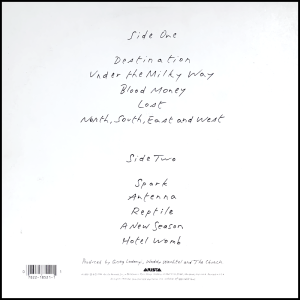
Starfish opens lugubriously with “Destination,” a track that I outright dismissed upon first listen. Hearing it just now, I admit admiration of the song’s weirdly obtuse lyrics (“In the space between our houses / Some bones have been discovered”) while still finding the chorus a bit boring. It might have worked better as a deep cut on the album rather than its opener.
“Under the Milky Way” is the single, and it holds up brilliantly. It’s clear that Wachtel and Ladanyi saw something in it, as great care was taken to render it for mass consumption. The fake bagpipe solo is pretty cool, and there are little synth whooshes that complement Kilbey’s voice perfectly. Along with “Everybody Wants to Rule the World” by Tears for Fears and “Running Up That Hill (Deal With God)” by Kate Bush, this is one of very select group of mid-to-late 1980s singles that has aged wonderfully.
“Blood Money” does absolutely nothing for me. The chorus is boring, the lyrics are meh, and the melody is nonexistent. I do like the way it ends, chords of electricity hanging in the air like droplets on a spiderweb.
“Lost” suffers from a similarly slow pace, especially on the chorus. The Church occasionally dabble in folk idioms styled after Bob Dylan, and although the guitar solo rings pleasantly it feels diluted. The good news for Starfish is that things get much better from here.
“North, South, East, and West” is terrific. Ploog finally gets a chance to demonstrate his chops on the drums, Koppes and Wilson-Piper trade riffs like a warmup for “Marquee Moon,” and Kilbey sounds rejuvenated. This is the band’s response to being trapped in Los Angeles with two producers who reportedly didn’t much care for their music, and the hostile lyrics reflect that energy: “The real estate’s prime and the number plates rhyme…Wear a gun and be proud but bare breasts aren’t allowed / In this city.” A winner.
Turn the record over, and we get the Anglophile pop of “Spark.” This is one of few Church tracks written and sung by Wilson-Piper, and it breathes some new life into the album. There are Church fans who believe that Wilson-Piper should have received more opportunities to sing on the band’s albums, and this song could be cited as evidence.
“Antennae” brings back the Dylanesque folk vibe, but with much better results. Kilbey sounds like he’s enjoying himself, especially on the chorus, and this song has all the variety and drama that “Lost” lacks.
“Reptile” is a Church classic. The guitarists are in absolutely peak form on this driving rock anthem, and Kilbey’s lyrics are more to-the-point than any in the band’s previous existence. For all the flak Kilbey sometimes gets for being overly cryptic and too dependent on facile rhyming, there are moments when he authoritatively nails it in the words department. The chorus alone is like a master’s thesis in allegory: “Go, go now you’ve been set free / Another month or so you’ll be gorging on me / With your lovely smile / I see you slither away with your skin and your tail / Your flickering tongue and your rattling scales / Like a real reptile.” The tempo is exciting, the drumming spot-on, and the guitars turn up the heat as this excellent track reaches its crescendo.
Peter Koppes takes his turn on vocals for “A New Season,” which is a shame because he can’t sing a lick. I love the song musically and believe a Kilbey vocal would have made it even stronger. As it is, it’s a pleasant enough deep cut that makes me wince a bit.
That slight blemish is forgivable, because the closing track “Hotel Womb” is another Church classic. Unlike “Destination,” this song earns its points by generating waves of dramatic tension. Kilbey tells a tale that is part Indiana Jones, part Eros worship, and part chemical escapism. Interpretations of the songs lyrics have ranged from a bad trip to cannibalism, but what I hear is a simple recounting of safe harbor: “I say, why are those buildings swaying like trees? / I say, can we stop for a while? / She says, can’t you hear the city that’s hidden in there? / It’s just another mile / I dream I’m safe in my hotel womb / Soft and soul-made, it’s a wonderful room.”
I once saw Kilbey perform an acoustic solo set in Washington DC, where he poked fun at his own writing process and specifically songs like “Hotel Womb.” He then launched into a captivating version of the song that enraptured everyone in the room. A tour de force for the entire band, the studio version of “Hotel Womb” is a great closer on a relatively uneven album.
Aftermath
It bugs me somewhat that a subset of American audiences still regard the Church as one-hit wonders. That’s the downside of releasing a timeless single, especially during the pre-Spotify era when singles were the music industry’s sole barometer of quality.
“Under the Milky Way” propelled the Church to the status of college-rock royalty. Their half-decent-but-heavily-flawed follow-up album Gold Afternoon Fix did reasonably well commercially. Success came at a cost, however. Over the ensuing decade, the Church were plagued by band defections (Ploog and Koppes, initially) and chemical dependency (most notably Kilbey’s heroin addiction, which he eventually conquered).
The Church have continued to release albums over their lengthy existence of nearly six decades. Some are quite strong; I consider Priest=Aura and Forget Yourself to be the best of the post-Starfish era, with a few clunkers thrown in for variety (looking at you, Magician Among the Spirits).
I give a lot of credit to drummer Tim Powles, who officially joined the band in 1994 and provided a stabilizing influence. Although Koppes and Wilson-Piper are no longer part of the band, the Church continue working to this day. Their most recent album, The Hypnogogue, was among their most critically applauded offerings yet.
However one feels about Steve Kilbey’s overt mysticism and abstruse lyrical content, no one can deny his work ethic: Kilbey’s non-Church discography alone consists of nearly sixty releases over the past four decades. Now 71 years old, Kilbey can reasonably claim to be one of Australia’s greatest songwriters.
Factoring in his various collaborations and side gigs, I even might argue that the totality of Kilbey’s aesthetic is more convincing beyond the purview of the Church. With that in mind, I must credit Starfish for helping Kilbey fund a lifelong career of creative interests. There are worse things.
Reply