Pere Ubu
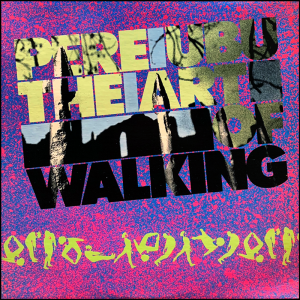
I will always thank Chris One for introducing me to Pere Ubu. Who’s Chris One, you ask, and why is this person called Chris One? Allow me to explain.
Upon arriving at art school in the fall of 1987, I was introduced to my roommates Christopher and Mike. My sophomore year, I lived with my friend Kystoff (Krys for short) in an off-campus apartment. When he went to Paris for a semester, Chris Three took his place. During my senior term, I moved in with my then-girlfriend/now-wife to complete the Chris quadrangle.
Somewhere in 1988 or so, Chris One pulled out a live album by Ubu entitled 390° of Simulated Stereo. “If I know you at all, I think you will love this band,” he declared. I was immediately intrigued: the buzzing dissonance of an EML 200 synthesizer, the guitar noises both creating and battling chaos, the rhythm section pile-driving propulsive melodies into my brain.
Sitting atop all this cacophony was a shrill lead vocalist screaming stuff like, “At night I can see the stars on fire / I can see the world in flames / And it’s all because of you / Or your thousand other names.” By the time we reached the climax of “Street Waves,” where everything breaks down for several minutes of free-form abstraction before seamlessly falling back into pocket, I was instantly hooked.
Despite the group’s original intention to release one single and disband, Pere Ubu has sustained a lengthy career that rewards the adventurous listener. From Cleveland avant-garage legends to Dada-pop deconstructionists, amid multiple lineup changes and sonic permutations, the band’s central figure has always been lead vocalist (I can’t really call him a singer) David Thomas. Both with Ubu and as a solo artist, Thomas’ imposing presence and peculiar creative vision has produced a discography spanning nearly six decades. For this review, I chose to explore The Art of Walking, arguably the most “art” of this art-rock collective’s early output.
Background
Pere Ubu is a band that has always seemed to exist at some sort of crossroads, and the end of 1979 was no different. Founding guitarist Tom Herman had left the group after the recording of their third album, New Picnic Time. His sonic imprint was important to the band, adding a tougher blues sensibility to offset the more dissonant contributions of synth (and occasional sax) player Allen Ravenstine. Ubu was certainly a unique listening proposition in those days, but Herman ensured that the band never strayed too far from frat-rock conventions.
With Herman’s departure, however, there was a void to be filled. Enter Mayo Thompson from Texas, leader of the legendary improvisational band Red Krayola. On paper, at least, one might have expected the pairing of Thomas and Thompson to embrace abstraction and move Ubu further from their primal origins. To these ears, however, that is only partly accurate. A few tracks from The Art of Walking take the form of spoken-word pieces backed by audio sculptures, while other songs retain the joyful atmosphere of their earlier work. I am a fan of both, so I approve.
My copy of The Art of Walking is a vinyl release on the Rough Trade label. The first U.S. pressing is noteworthy for including two tracks mixed incorrectly, including a vocal overdub that wasn’t supposed to be used for “Arabia,” and a piece entitled “Miles” that was intended to be called “Young Miles in the Basement.” Subsequent reissues of the album have corrected these flaws, but I played the album frequently enough that the “correct” versions sound wrong to my ears. Ah well.
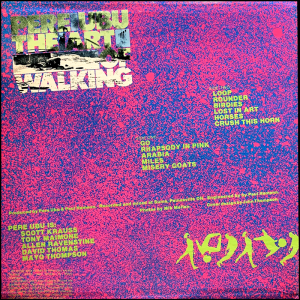
Tracks
The first sound you hear on The Art of Walking is the opening of “Go.” Thompson’s trebly guitar propels a solid backbeat, offset by the occasional whoosh of Ravenstine’s synthesizer. This was the instrumental formula during this period of Ubu’s existence, and it demonstrates the important contributions of bassist Tony Maimone and drummer Scott Krauss to the band’s overall aesthetic. The intro goes on for a few bars before David Thomas enters warbling his plebeian message: “Here’s to the small things / Here’s to the small things that give pleasure / Here’s to the everyday things / Here’s to the everyday things that bring a smile.” Although I would hesitate to call The Art of Walking a concept album, Thomas does set the stage for an overarching thesis: life is comprised of simple moments that are too frequently overlooked, and even the act of walking to the bus stop creates its own sense of drama. A great opening track.
“Rhapsody In Pink” follows, the first of several abstract tone poems on the album. Everything slows to a crawl, weird instrumental noises bubble in and out of the mix, and Thomas begins a spoken narrative about sitting underwater while schools of fish stare at him. If you’re familiar with Thomas’ solo albums (Monster Walks the Winter Lake comes to mind), you’ll know that these shaggy-dog tales are something of an oeuvre for Thomas. Extrapolating any sort of meaning from Thomas’ words is a task left to the listener’s discretion. When Thomas closes the track with a simple piece of advice (“Let this be a lesson to you”), it may be difficult to glean what exactly his intentions are. It may also be argued that the point he ‘s making isn’t all that complicated: if you decide you want to live in the ocean, at some point the waves will excommunicate you back to dry land.
“Arabia” is the third track, and this is where things get truly weird. As mentioned, my vinyl copy features a Thomas vocal overdub that was later removed when the album was reissued. The material impact is negligible to these ears, as Thomas’ voice operates mostly as another sonic device in the Ubu tapestry. For nearly six minutes, there are organs and synths and guitar chords and strange percussion sounds. This is Ubu at their most whimsical, a sort of nursery rhyme in the form of audio collage.
On my copy, “Miles” is the fourth track and oh my god. There’s some sort of horn bleating in the background, Thompson lays down a few dramatic chords on the Hammond organ, a rhythm box (maybe a CR-78) makes little clicky noises, that same whooshing sound from “Go” reappears, and of course there’s Thomas’ voice chanting like a deranged ghost from the Cask of Amontillado. Great stuff.
“Misery Goats” closes side one, and it’s a welcome return to something resembling a song structure. Maimone and Krauss take control here, laying down a groove that I can only describe as funky, while Thomas chirps a positive message of sweetness and light: “Don’t fret now baby / Don’t be so tired / No mope mope mope-a-dope / No it’s not as bad as all of that / Don’t be no misery goat!” My favorite part of the song comes after the bridge, where Thomas goes into another mode: “Now look here / Lookee here now / Here comes the poetry / I’m a cave with the wind inside / I’m a shell with the sound of the surf inside / What? What’s the point hunh?” I love me some self-referential humor, and whether Thomas poking fun at himself or the overall pretentiousness of life, I can’t say. I know that this song slaps, and having seen Ubu perform it live I must make special mention of Maimone’s intricate yet rhythmically solid bass lines.
Flipping the record, we open side two with the quiet-yet-intense “Loop.” The Red Krayola influence starts to seep in here a bit, as we hear Thompson and Thomas sort of half-singing together. It’s Thompson who appears to carry the lyrical content, in fact, while Thomas accompanies him making onomatopoetic animal noises. In terms of the actual lyrics … well, read for yourself: “Are things clouds or clocks? / What’s a swarm of gnats got to do with a pile of rocks? / What have a bucket and a clean slate got in common?” Who knows what these two wingnuts are banging on about, but I love the track and consider it an essential Ubu deep cut.
The drums return for “Rounder,” only the tempo is a bit more relaxed. It’s not rock, it’s not art, it’s not exactly art-rock, but it makes its own sort of sense in the Ubu universe. There’s some syncopated claps accentuating the beat, Thompson repeats a nagging little riff on guitar, and Thomas tells us a hero’s story about self-torment.
That’s followed by the insane brilliance of “Birdies,” where the entire band picks up the pace. Krauss’ drumming creates a labyrinth of patterns, Thompson’s guitar emits sparks of electricity, Maimone hits notes on the bass that really shouldn’t exist, Ravenstine spreads his space-cream frosting all over everything, and Thomas shrieks: “I gotta get hold of myself / I’m gonna have to pull myself up by my socks / I’m gonna have to grab myself by the shirt collar and shake.” What has our David feeling so perturbed? Well, it seems that the birds are doing a better job of expressing his thoughts than he is, so he’s decided to go for a walk. The only problem is that’s not going very well, either, but like any good protagonist our narrator perseveres. Every time he trips or falls down, he gets back up, and once he gets going we’re treated to a running itinerary of everything he sees: “A tree a dog a cat a house / A car fireplug mailman mom and dad / Dumpdee dump dumpda-de-dee / Look at me!” The whole thing would be ridiculous if the music wasn’t so sublimely, batshit-crazy awesome. An Ubu classic.
“Lost In Art” brings the album down a bit, as it’s nearly five minutes of mucking about in the studio with the microphones on. Thomas yells “Gimme gimme gimme” over a staccato marching snare amid what sound like kitchen utensils being randomly dropped on the floor. Skip this one.
“Horses” comes next, a countrified jaunt with relatively conventional lyrics. If it doesn’t sound quite like Ubu, that’s because it shouldn’t; the song is a remake from Mayo Thompson’s 1970 solo album Corky’s Debt to His Father, and he sings lead while Thomas does some vocal murmuring in the background. An effective diversion.
The album closes with “Crush This Horn,” a dissonant but brief audio experiment in full sonic endurance. I’m reminded of early Cabaret Voltaire, of all people, or maybe even the Residents. One gets the sense the band were running a bit short of ideas here.
Aftermath
Krauss was replaced on drums by Anton Fier before the recording of Ubu’s final album with Mayo Thompson, Song of the Bailing Man. The band then went into hiatus before reforming in the late 1980s with Jim Jones on guitar and Krauss returning on drums. Thus began a more commercially viable phase that netted Ubu some radio play and television appearances. I saw them on both the Cloudland and Worlds In Collision tours, and those were among the best live performances I’ve ever seen by a rock band.
Ubu persists today in various forms, and ostensibly the band will continue to exist as long as David Thomas is sufficiently healthy and interested in maintaining it. Every few years, Thomas releases a statement announcing Ubu’s final album or goodbye tour, only to be followed some time later by a new Ubu project with a new Ubu lineup. Their most recent albums are as vital and exciting as any in their extensive catalogue.
For me personally, The Art of Walking retains a special place in my listening journey. The album’s cryptic eccentricities, coupled with its quirky yet uplifting subject matter, have always held me captive to Ubu’s proletariat surrealism. I know many people who find Ubu to be unrelentingly bizarre. Although I cannot dispute that assessment, I would counter that the elastic mind of David Thomas is teeming with undeniably positive energy. For those willing to engage with Ubu’s more challenging material, I advise you to get a hold of yourself, pull yourself up by your socks, and don’t be no misery goat.

Reply