Donald Fagen
Classifying the music of Steely Dan as “yacht rock” is an egregiously facile example of genre-baiting. Born in New Jersey, educated at Bard College, steeped in the subculture of New York City, and a fanatical scholar of Beat literature, Donald Fagen is unlikely to be seen within a nautical mile of any sun-splashed harbor of opulence. Donald Fagen is not Christopher Cross.
Too intelligent and cynical for fans of, say, the Doobie Brothers, Fagen and his partner Walter Becker pursued a brainy form of “rock and roll” for the better part of the 1970s. Steely Dan’s crisply recorded music referenced jazz and Latin influences, often employing tonal scales and inverted chord structures to enrich their songs. The band’s cryptic lyrics, mostly written by Fagen, explored deep philosophical ideas in the form of ironic personal narratives. The fictional characters created by Fagen typically endured disturbing situations from the seedier recesses of urban life, representing themes of alienation, obsession and denial.
After Becker experienced a series of legal and personal issues (including substance abuse and injuries suffered from an automobile mishap), Steely Dan dissolved their partnership in 1981. Becker moved to Hawaii to get clean and become an avocado farmer. Fagen hibernated for eight months in a New York studio to record his first solo album, The Nightfly, which I consider to be an underrated masterpiece of the early 1980s.
Background
The Nightfly was one of the first albums to be fully recorded using digital equipment. At the time, the typical method was to record analog to magnetic tape. Digital recording allowed for a cleaner and more exact reproduction, but it wasn’t an easy journey. The engineers had to take classes at 3M’s Minnesota headquarters to learn how to align the company’s machines, and equipment breakdowns necessitated a visit by 3M’s technical support team on at least one occasion.
Many of the vocal and instrumental tracks were recorded using a process called comping. Multiple takes were recorded, spliced, and reassembled using a computer to select the best fragments from each performance. On a few songs, guitar or piano was recorded twice to a click track and then split between left and right channels to enrich the sound.
A number of guest musicians were recycled from previous Steely Dan albums, including such session luminaries as Jeff Porcaro, Rick Derringer, and Larry Carlton. Over thirty musicians are credited with having performed on the album. That list does not include the 16-bit Wendel II digital drum machine, a device built specifically for the purpose of plugging it directly into the recording console.
If the creative process sounds laborious, that’s because it was. It likely didn’t help that Fagen initially struggled to complete new songs without his longtime partner. The music is jazzier, simpler, and less inclined to Steely Dan’s more avant-garde leanings. Also in comparison to his work with Steely Dan, the lyrical tone Fagen created for The Nightfly is warmer and more romantic. The autobiographical themes that emerge in the lyrics are drawn from Fagen’s adolescence, creating a feeling of nostalgia and reminiscence.
Although it is not what I would call a “concept album,” the eight tracks on The Nightfly share a loose thematic bond of idealism in a time of political and social turbulence. This is what it must have been like to grow up in suburban New Jersey in the late 1950s: weekend barbecue parties with the neighbors, Cold War tensions amid the threat of Communism, sexual repression instigating high school romance, and a persistent hope that a peaceful, enlightened future was just around the corner.
Tracks
With a lightly tapped cymbal ringing against vaporous synth arpeggios, The Nightfly kicks off with the splendid “I.G.Y.” The song’s title refers to the International Geophysical Year, an event that took place between July 1957 and December 1958 to celebrate the scientific interchange between Eastern and Western countries. Among its beneficial outcomes were the Antarctic Treaty, which codified the use of the Antarctic continent for peaceful and cooperative scientific research, and the formation of a repository called The World Data System.
Musically, the playing on “I.G.Y.” is immediately appealing: gooey electric piano chords form the basic structure, with a gentle application of guitars, brass, synth, and percussion keeping pace. Fagen’s lyrics present a confident vision of postwar 1950s American optimism: “Standing tough under stars and stripes / We can tell / This dream’s in sight / You’ve got to admit it / At this point in time that it’s clear / The future looks bright.” The future our narrator describes is a solar-powered Utopia where everyone is an artist, the weather is always perfect, important decisions are made by benevolent computers, and “there’ll be spandex jackets for everyone.” During the chorus, a group of background vocalists sweetly croon, “What a beautiful world this will be,” adding a slight element of suspicion to the cheerfully conveyed sentiments.
“Green Flower Street” is an uptempo tune with a dark undercurrent. The lyrics describe a mixed-race romance with an Asian female (“That’s where I found my mandarin plum”) in a rough Greenwich Village neighborhood that “reeks of wine and kerosene.” Things don’t get much better when a presumed racist brother gets involved (“Lou Chang / Her brother he’s burning with rage”). I have also read interpretations that the song is about a drug deal gone wrong. Regardless, the musical backdrop is peppy and syncopated, and the guitar solo by Carlton is divine.
“Ruby Baby” is a swinging cover of the 1956 Drifters tune. It bops and jives for two verses before dipping into a jazzy piano solo by Michael Omartian. The brass and organ take turns flicking at each other before Fagen sings the third verse. The end of the track features the sound of a party that, according to legend, was originally to be recorded at Studio 54. It’s low-key fun, daddy-o.
“Maxine” is a folksy bit of cocktail jazz that closes side one. Fagen’s vocal performance is among his best on the album; the teenage narrator sings to his girlfriend (”We’ve got to hold out till graduation / Try to hang on Maxine”) in a four-part harmony arrangement recalling the Four Freshmen. It’s terrific, and I also love the cheesy organ rolls during the song’s bridge.
Side two opens with “New Frontier,” arguably the album’s thematic and musical centerpiece. The lyrics describe a teenage party that just happens to be taking place in a backyard bomb shelter: “Yes we’re gonna have a wingding / A summer smoker underground / It’s just a dugout that my dad built / In case the reds decide to push the button down / We’ve got provisions and lots of beer / The keyword is survival on the new frontier.”
This is no sanctimonious commentary on foreign relations, however. Our young narrator has more important things on his mind, like getting to first base with that blonde girl in his class who’s “got a touch of Tuesday Weld.” It’s a perfect encapsulation of everything we might imagine about the state of affairs between Russia and the United States in the late 1950s, demonstrated through the dual lens of suburban paranoia and teenage lust. While Dwight D. Eisenhower and Nikita Khrushchev were at Camp David in an attempt to de-escalate Cold War tension, a young Donald Fagen raged with hormonal desire while connecting with his crush: “Do you have a steady boyfriend / Cause honey I’ve been watching you / I hear you’re mad about Brubeck / I like your eyes, I like him too.” Genius. And the music is spot-on, featuring a deliciously inappropriate yet perfect harmonica solo by Hugh McCracken.
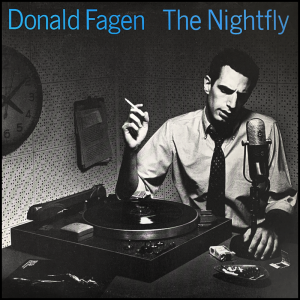
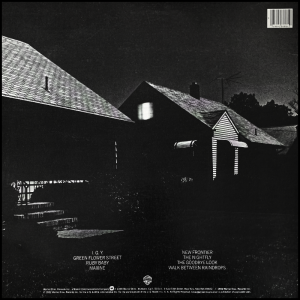
“The Nightfly” is the album’s title track, ostensibly describing the character Fagen depicts on the album’s cover photo: a lonely radio DJ sitting at a 1950s-style microphone, surrounded by tiled acoustic paneling, speaking out the corner of his mouth while waving a Chesterfield in the air, about to spin a Sonny Rollins record because it’s 4:08 AM and he’s in that sort of mood. Turn the album over, and we see a dark suburban neighborhood with a single light glowing from an upstairs window. This is the headquarters of independent radio station WJAZ, hosted by Chester the Nightfly, offering a mix of jazz music and live conversation where no topic is off limits: “So you say there’s a race / Of men in the trees / You’re for tough legislation / Thanks for calling / I wait all night for calls like these.” There is a wistfulness to the lyrical content, especially during the chorus when Fagen describes the sun peeking through the skyline as morning arrives.
“The Goodbye Look” is the album’s study in early 1960s bossa nova, but don’t be fooled by the song’s breezy atmosphere. The lyrics are like something out of a Hemingway novel, our protagonist having the time of his life on an island of sun, surf, and amaretto cocktails. Then a violent revolution changes everything: “All the Americans are gone except for two / The embassy’s been hard to reach / There’s been talk and lately a bit of action after dark.” From the context of the lyrics and album in whole, we may safely assume that the island is Cuba and the new regime is led by Fidel Castro. It’s clear to the narrator that he needs to leave the island, and quickly, so he hires a boat to avoid the “small reception … they’re arranging just for me.” Alas, it may be for naught when he reveals that he may have known this was coming all along: “I know what happens, I read the book / I believe I just got the goodbye look.”
“Walk Between Raindrops” is a brief and straight-laced love song, featuring an exquisite swing beat and an awesome roller-rink organ solo. It ends The Nightfly on a happy note, describing the meeting of two lovers after an argument they no longer remember having. It’s a sweet, warm pastiche that closes the album with a feeling of joy.
Aftermath
The Nightfly did well commercially, especially in Sweden and New Zealand, but not as well as Steely Dan’s albums to that point. The album remains a favorite among audiophiles who revel in its recording clarity and fidelity. In terms of sound quality, in fact, The Nightfly is considered one of the greatest recorded albums of all time. Today it remains a critical favorite and often appears on “Best of the 80s” lists. It was eventually certified platinum and nominated for a Grammy Award.
Fagen and Becker reunited in 1993, when Becker produced Fagen’s second solo album entitled Kamakiriad. The two then embarked on a Steely Dan reunion tour and released two more albums. Becker sadly passed away in 2017, leaving his widow to sue Fagen over control of band shares. Fagen considered retiring the Steely Dan moniker, eventually relenting to promoters who persuaded him to continue touring under the name. An ersatz version of Steely Dan continues to headline the Boomer nostalgia circuit to this day, although Fagen’s activities have slowed due to health issues.
I like to think The Nightfly as a collection of musical short stories, with all of the album’s protagonists achieving happiness and success. The teenager from “New Frontier” ended up marrying his crush Maxine, the ex-patriot from “The Goodbye Look” safely escaped assassination, Lou Chang and his future brother-in-law became good friends, Chester the Nightfly found companionship in something other than his cigarettes, and all of them live together peacefully in an ecological bio-dome wearing matching spandex jackets.
Reply