David Van Tieghem
If you search the deepest part of YouTube, you will find two video pieces by the percussionist David Van Tieghem. The first is Ear to the Ground, a 1981 work in which New York City serves as a giant musical instrument. A camera follows Van Tieghem walking the streets as he taps his mallets against sidewalks, brick walls, telephone booths, traffic lights, and whatever else happens to appear in his travels. The plot thicken in the 1987 sequel, titled Ear-Responsibility, in which Van Tieghem similarly transforms simple domestic chores into percussive rhythms. The video ends with Van Tieghem portraying a sort of Pied Piper figure, surrounded by a merry group of followers each equipped with a pair of drumsticks.
This sort of thing is prevalent all over social media nowadays, where any nitwit can make a spectacle of themselves and post it for global consumption. In the 1980s, it took a bit more verve (not to mention talent) to execute and produce a valid piece of conceptual art. A live appearance on Late Night With David Letterman in 1983 proved that there was more to Van Tieghem than a couple of silly videos; the Dadaist with the appearance of a tax accountant could actually play. The persona I glean from Van Tieghem is one of my favorite types: a serious musician who doesn’t take himself too seriously.
It certainly helps that Van Tieghem has the resume to support his smartypants wiseacre adventures. The list of artists with whom he’s collaborated reads like a “who’s who” of the New York music scene, both underground and mainstream. Steve Reich, Talking Heads, John Cale, Pink Floyd, Nona Hendryx, Robert Fripp, Arthur Russell, Duran Duran, Adrian Belew, Ryuichi Sakamoto, Arto Lindsay, Bill Laswell, Jon Gibson, Tony Williams, Robert Ashley, Anton Fier, and countless other artists have employed Van Tieghem as a freelance percussionist or composer. He was an early member of the Love of Life Orchestra with Peter Gordon, and he can be seen playing drums and electronic percussion in Laurie Anderson’s 1986 concert film Home of the Brave.
Van Tieghem’s solo albums tend to document the music he scores for ballet and theatrical performances. These Things Happen is the soundtrack to Fait Accompi, a work commissioned by dancer and choreographer Twyla Tharp. Although the frenetic energy of Van Tieghem is best experienced watching him spontaneously interact with his materials, the album does occasionally elevate from being a dry, overly academic sonic exercise.
Background
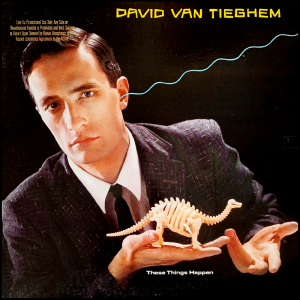
Van Tieghem was already a New York presence by 1984, the year he recorded These Things Happen. It was not his first musical work, although it was the first to be released as an album attributed solely to his name. The cover art combined with the album’s title has always cracked me up.
The album’s musical landscape covers a variety of styles, from non-Western rhythmic pulses to icy, avant-garde pop. Van Tieghem’s palette employs found sounds (like radio transmissions and recorded animal noises) combined with an array of unconventional materials; along with traditional percussion instruments, Van Teighem’s kit includes wine bottles, hair combs, ashtrays, balloons, random scrap metal, and other detritus. Even with all of these implements at work, the musical output never veers into cacophony or chaos. That is actually one of my slight criticisms of the album, in fact; I sort of wish the album was a tad more experimental in that regard. A bit of noise is not a bad thing.
My vinyl copy of These Things Happen is a radio promo, likely purchased on a record-shopping excursion to New York in the early 1990s. Long out of print, the album can now be digitally streamed from Van Tieghem’s Bandcamp site.
Tracks
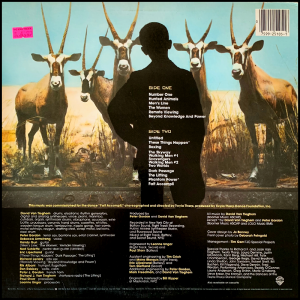
These Things Happens begins with the appropriately titled “Number One.” We hear the sound of a radio transmission amid of synth arpeggios and electronic percussion patterns. About halfway through, there is a beautiful saxophone solo by Peter Gordon, who also happens to be Van Tieghem’s partner in the Love of Life Orchestra.
The opening track then crashes seamlessly into “Hunted Animals.” The radio transmissions become more ominous and the pace slows down a bit. There are lots of fun little blips and blorps, including was sounds like monosyllabic vocal samples and blurts of sax played in reverse. The atmosphere is compelling, but it doesn’t develop much beyond the initial impression.
The very short “Men’s Line” features a drum beat I can only describe as pre-industrial, and I’m somewhat reminded of bands like Skinny Puppy or Cabaret Voltaire at their most benign. This being the New York avant-garde, of course, we get a scraping violin solo by Ron Robboy. This takes the track slightly into sonic territory inhabited by fellow arty eggheads Tuxedomoon. (Imagine a more complex version of “The Waltz” from their album Holy Wars).
“Men’s Line” is immediately followed by the album’s highlight for me, “The Women.” The polyrhythms lock into place perfectly behind a stellar guitar riff by Randy Gun. What makes this piece really work are the female vocals, ostensibly by Rebecca Armstrong, which add a bit of humanity and warmth to the overly sterile presentation. Two minutes is too brief a moment for something this strong, and I wish more of the album explored this intersection between human and machine.
“Remote Viewing” syncopates marimbas and electronic drums behind an alto sax solo (this time played by Richard Landry) and more vocals by Armstrong. It sounds like the chase scene of an early 1980’s movie, the protagonist trying to escape a dystopian landscape populated by evil toasters. Splashes of electric guitar and piano bass notes contribute to the noisy din, and the ending becomes very Reichian in its phasing.
Side one closes with “Beyond Knowledge and Power,” beginning with ascending chord sequence before locking into a deep sawtooth synth groove. As with the rest of the album, one must admire the impeccable stamina and precision. Also as with the rest of the album, the piece doesn’t develop much beyond its busy rhythmic tapestry. We do get another nice sax solo by Landry, which plays well against the vocal accompaniment of Armstrong. This is the point where I wish a bit more of Van Tieghem’s oddball personality would emerge, the way Erik Lindgren’s sense of humor provides a counterpoint to the ‘serious’ musical personage his band Birdsongs of the Mesozoic often presents.
Turn the record over, and side two opens with a fast-paced drum-and-piano intro to the title track “These Things Happen.” This is the closest the album gets to a proper song, with actual chord changes supporting a strong dance beat. The build is more effective this time; we get to hear distorted guitars, sirens, more radio transmissions, and other strange noises before it all crashes to a satisfying close. It might be the second-best moment on the album.
I confess the rest of the album has always remained a bit of a blur for me, which is a shame because “Boxing” is the perfect follow-up to “These Things Happen.” The percussion rhythms are still clattering away, but this time the mood is much more subdued. I love the subtle little piano chords and disquieting atmosphere, which ends just a little too soon.
We are then treated to the six-minute suite entitled “The Skyway/Walking Men #1/Scavengers/Walking Men #2/Two Worlds.” There are moments of beautiful disruption, such as what sound like cans of water being tapped, and I wish the lovely little synth interludes were given more space to develop into fully realized concepts.
The brief “Dark Passage” follows that, and it’s exactly as the title describes: a deeply foreboding synth rhythm that leads into “The Lifting.” By this point in the album, the sonic vernacular is more than familiar to our ears. And while it’s all quite agreeable, I can’t help recalling a school field trip to the State Museum planetarium when I was twelve years old. The music Van Tieghem creates on These Things Happen is nearly identical to what I remember hearing as I gazed up at that ersatz night sky.
“Phantom Power” reprises the drum pattern of “The Women,” only this time the female vocals are replaced with Van Tieghem’s own sighing and moaning. It’s a bit weird and creepy, to be honest. Thankfully, that interlude transitions into “Fait Accompli” to conclude the album. There’s some sort of zither or other metallic percussion adding a new color to the canvas, and I love how Armstrong’s vocals provide a strong counter to the track’s more assiduously mechanical attributes. As with all the preceding tracks, however, I wish the musical journey we’ve asked to undergo had more of a beginning, middle, and end.
Aftermath
Van Tieghem’s career has thrived over the past three decades. Besides releasing his subsequent studio albums Safety In Numbers and Strange Cargo, Van Tieghem has composed award-winning music for Broadway productions and film scores. He was nominated for 1998 Drama Desk Award for Sound Design in 1998 and 1999, and in 2007 he was the recipient of a Guggenheim Fellowship in Music Composition. Today he mentors students on music composition and sound design at universities across North America.
These Things Happen is one of those albums that I admire more than love, if that makes sense. Its brief tracks were perfect fodder for creating mixtapes, providing transitional interludes between songs by latter-day Hüsker Dü and early-period Golden Palominos. Listening to it for the purpose of writing this review, I was surprised how many genuinely great moments there were to be discovered. Taken as a totality in one sitting, however, I can understand anyone who taps out after twenty minutes. But don’t let that stop you from entering Van Tieghem’s fascinating world.
Reply