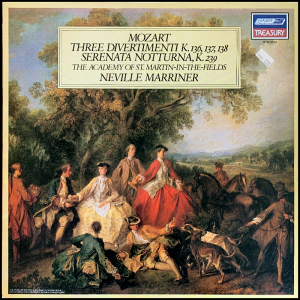
Mozart, The Academy Of St. Martin-in-the-Fields, Neville Marriner
Let’s get something straight: a scrub like me has no business evaluating one of the greatest classical composers who ever lived, let alone assigning a grade to a recording of his work. If I’m being completely honest, I bought this album in a used record shop for wholly superficial reasons: I was on a classical music kick, I wanted some Mozart in my collection, and I liked the cover painting. That probably makes me some sort of philistine, but to paraphrase the great philosopher Boz Scaggs: it’s the sad old truth and the dirty lowdown.
Despite my admitted lack of musical percipience, I believe I still have some ability to recognize that not all quality is subjective. In the same way that conventional behaviors eventually manifest into trends, classic compositions earn their legacies. Good music is good because it works. Placed in the capable hands of Englishman Sir Neville Marriner, often described as one of the world’s greatest conductors, Mozart’s compositions shimmer with a nuanced complexity. This album transcends the “background music” one might hear while browsing the local Barnes & Noble.
Background
As a conductor, Neville Marriner’s discography boasts over 600 recordings covering 2,000 different interpretations of baroque and classical music. Briefly a music teacher and trained in violin, Marriner founded the Academy of St. Martin-in-the-Fields in 1958. This twelve-member chamber ensemble soon expanded to a full orchestra, gaining the reputation of attracting the highest caliber musicians to its roster. Originally serving as lead violinist, Marriner later focused his attention to conducting. He remained the collective’s musical director until 2011.
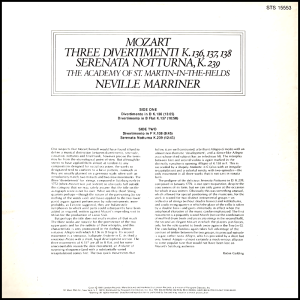
One of the most prominent composers of any time period, the child prodigy named Wolfgang Amadeus Mozart wrote Three Divertimenti, K.136, 137, and 138 in Salzburg at the age of sixteen. It was composed originally as after-dinner music to be played at social functions. Serenata Notturna, K.239 was written in Salzburg four years later for soloists and orchestra, modeled after the Italian three-movement form of sandwiching a slow part between two fast parts.
This particular album is part of a series of classic recordings released on the British label Decca during the 1960s. Critics of classical music, who know a lot more about that sort of thing than I would, cite this particular recording as having the one of the best string tones captured on tape. I remember listening to this after having oral surgery in 1992. Mozart and oxycodone blend well together.
Tracks
The highly recognizable opening bars of Divertimento In D Major, K.136 kick off “Allegro.” The pace is lively and brisk, and one imagines an 18th century scene of European royalty in powdered wigs frolicking by candlelight. There is a an interesting mood change just after the two-minute mark, where the main theme is re-imagined in a different tonal scale. The arpeggios at the 2:45 mark create a nice transition back.
“Andante” slows things down a bit, allowing the listener to revel in the composition’s balance and clarity. At about the three-minute mark, the arpeggios once again return the listener to the movement’s primary theme.
“Presto” opens quietly before quickening the pace. This is where the string tone comes through in the mix, all those violins and violas contributing to a single voice. Not being a music conductor, I could not begin to imagine how difficult it must be to orchestrate multiple players with this level of precision. I can barely get four people in a meeting to agree on something in a typical working day, but that gripe is for a blog yet to be written.
“Andante” introduces Divertimento In B Flat Major, K.137. It’s a rather sedate affair, and I quite like the mood changes throughout the piece. Listening more closely, one might appreciate the interesting pauses Mozart intentionally placed as compositional devices.
“Allegro Di Molto” brings back the frolic. I found that my attention this time was drawn to the cellos, a voice not typically associated with rhythm, but here there is a crunch to their timbre that operates much like a percussion instrument.
“Allegro Assai” closes both side one and Divertimento In B Flat Major, K.137. For some reason, I envisioned shapes while listening to this piece just now. Each instrument creates its own structure, with all voices layered together to form a composite.
Divertimento In F Major, K.138 opens side two with “Allegro,” it’s six-part ascending chords forming the basis of what is essentially a dance. One can hear Marriner playing with the volume of each section, using the recording space as a creative element.
“Andante” has a strangely forlorn quality, almost melancholy in feel, and for that reason it is the most intriguing all all the pieces on the album to these ears. I quite like how the cellos take over halfway through the movement, and their separation from the violins’ higher registers is sublime.
“Presto” brings back the happy by employing what I can only describe as a riff. There is an authentic chorus-verse-chorus structure to Mozart’s compositions, which perhaps explains their universal appeal over the past 200-plus years.
“Marcia” from Serenata Notturna, K.239 features an actual percussion keeping time while also supporting the melody. I’m reminded of how Ringo Starr’s drum lines for “Ticket to Ride,” “Come Together,” and “Tomorrow Never Knows” make those Beatles songs instantly recognizable, even if no other instruments are playing.
“Menuetto” offers some variations of the same theme from “Marcia,” albeit at a slightly more subdued pace, before “Rondo” closes the album with a lovely bit of strings. When the percussion comes back, it’s to emphasize a crescendo in the piece. The little drum rolls at the three-minute mark are almost startling; I wonder how audiences of that era took to drums being used in this fashion. We often forget that all music was new and original at some point in time. While I hesitate to assess the societal impact of Mozart at the same level as, say, the Sex Pistols, it may be fair to suggest that elements of his compositions may have seemed quite radical for that era.
Also … to repeat, Mozart was sixteen years old when he wrote these compositions. Sixteen! When I was sixteen, my most impressive accomplishment was sneaking out my bedroom window in the middle of the night without my parents knowing. Perhaps any analysis I offer on Mozart’s work should end there.
Aftermath
Mozart continued composing for the remainder of his short life, producing some of the world’s most recognizable music today. He was especially prolific during his time in Vienna, between 1782 and 1788, producing many concertos and operas that remain classical music staples to this day.
Mozart’s circumstances changed near the end of the decade. Due to the Austro-Turkish War, the aristocracy was less inclined to financially support composers. Mozart’s substantial income decreased, and a kidney infection combined with rheumatic fever contributed to his declining health. Borrowing money to support his family, he resided in various towns across Germany between 1789 and 1790 and attempted to recover his drive and stamina.
That period of recuperation must have helped, as Mozart’s final year was marked by high productivity. It was during this time that he composed some of his most admired words, including his opera The Magic Flute and the unfinished concerto Requiem K. 626. He also began to pay back his debts, thanks to annuities paid by wealthy patrons in Hungary and Amsterdam. He passed away in 1791 at the age of 36, two months after conducting the premiere of The Magic Flute in Prague.
Reply