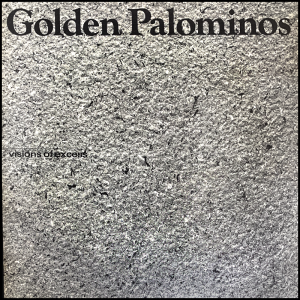
Golden Palominos
There is a small subset of cranky Gen-X curmudgeons who believe that R.E.M. passed their sell-by date around 1987, and I’m sorry to reveal that I am one of them.
Something happened when the band decided to amplify lead singer Michael Stipe’s voice from abstract to emotive: it became clear that Stipe’s command of language was nothing more than facile sentimentality. On the band’s early work, Stipe’s arcane mumbling revealed imaginative vignettes like “Heaven assume, shoulders high in the room” and “Time and distance are out of place here.” I had long lost the plot by the mid-1990s, when Stipe’s voice could be heard on mainstream radio bleating tripe like “Sometimes everything is wrong / Now it’s time to sing along.” I’ve read more compelling prose in my local airport’s Hudson Bookseller.
There was a time, though, when Stipe was the voice in what was then called “alternative” or “college” rock. He features prominently on the first three tracks of Visions of Excess by the Golden Palominos, a collective of bohemian virtuosos led by composer and percussionist Anton Fier. Considering the album’s 1985 release date, Stipe’s central role should not be considered a surprise. The work holds up today as a somewhat obsolete yet enjoyable artifact of the era in which it was recorded.
Background
Cleveland native Anton Fier formed the Golden Palominos in 1981 after moving to New York City. Having already served as the drummer in such seminal bands as the Feelies and Pere Ubu, Fier ensconced himself among a rotating roster of New York musicians who always seemed to be appearing together on stage and in various recording permutations. He later played on The Lounge Lizards’ debut album, a band from whom he enlisted members for what became the first incarnation of the Palominos.
According to at least one music journalist, early performances of the first Palominos lineup were legendary. Initially featuring guitar-scraping vocalist Arto Lindsay, bassist extraordinaire Bill Laswell, experimental godfather Fred Frith, and saxophonist John Zorn, the roster was expanded to include drummer Dave Moss and bassist Jamaaladeen Tacuma. With Fier also on drums, the double rhythm section packed a wallop while allowing the various soloists room to weave an art-funk tapestry of fascinating textures. By the time the Palominos released their debut album, their aggressive sound was somewhat more streamlined and diluted. Still, there were avant-garde touches, such as the addition of Mark E. Miller on turntables (it was the 1980s, after all) and Zorn’s occasional use of game calls.
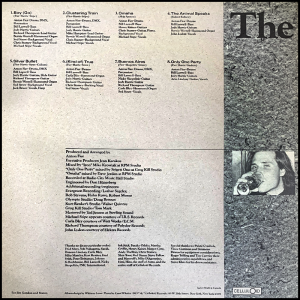
For the Palominos’ second album, Fier dispensed with most of the avant-funk trappings to focus on melodic, lyrical songs featuring a cast of jazz and rock luminaries. Visions of Excess reads like a “who’s who” of the decade’s musical ecosystem. Along with Michael Stipe and Arto Lindsay, the album’s contributors included John Lydon, Henry Kaiser, Bernie Worrell, Carla Bley, Richard Thompson, Jack Bruce, Chris Stamey, Henry Kaiser, and Jody Harris. This impressive musical pedigree was matched with emergent talent Syd Straw, at the time a little-known backup vocalist for Pat Benatar.
I bought my vinyl copy of Visions of Excess sometime during my heavy avant-garde phase, a point in time when I was consuming any recorded output whose liner notes listed Frith or Zorn as participants. I remember at the time being a bit disappointed by the album, believing that it wasn’t weird enough for my sophisticated musical palette. I later softened my stance, and today I remain a fan although I don’t believe all of its contents have aged equally well.
Tracks
The album starts with the stomping computerized drum pattern of “Boy (Go).” After a few graceful chords by twin guitarists Chris Stamey and Jody Harris, Michael Stipe kicks the track into gear with his unmistakable southern drawl: “Boy you trouble, boy you get / Ain’t take the lead / Sent on home a hurricane / Hitched it to your feet.” Who knows what he’s singing about, but it sounds great interspersed with the identifiable tone of lead guitarist Richard Thompson. Syd Straw chimes in on background vocals near the end, elevating the plodding rhythms. Essentially a showcase for Thompson and Stipe, it all hangs together agreeably.
“Clustering Train” starts off with a subdued Stipe whisper before exploding into a cacophony of heavy metal power chords. The rumbling chug-chug-chug rhythm is immediately appealing and gets my head bobbing. When Stipe growls the strange but accessible refrain “Snake walkin’, train riding / Song, not, yeah,” it’s a reminder of everything I used to love about early R.E.M. Bernie Worrell adds some lovely organ fills.
“Omaha” is an energetic cover of the Moby Grape classic written by Skip Spence. Stipe’s repeated yelping of the line “Listen my friends!” is either exciting or exasperating, depending on how you feel about chestnuts from 1967 being reinterpreted. To these ears, it’s all good fun but not something I find myself longing to hear more than once.
John Lydon begins “The Animal Speaks” with a charming belch. He then proceeds to slather the track with his characteristic ranting. You might mistake this for a mid-1980s offering by his band Public Image Ltd., which would be understandable given that Visions of Excess bassist Bill Laswell produced PiL’s fifth album just after Visions of Excess was released. This track is noteworthy for being a cover of a song by The Numbers Band (also known as 15-60-75), a Cleveland institution of experimental rock. Songwriter Robert Kidney toured with the Palominos the following year, in fact, and one suspects that Fier was paying homage to Ohio roots by including it on the album. I think it’s a hoot. The thrashing, driving guitars combined with Lydon’s yelping make for thoroughly entertaining listen.
Flip the record over, and we get “Silver Bullet,” co-written and sung by Cream bassist Jack Bruce. This track has the same industrial chugging rhythm as “Clustering Train” with a slightly more relaxed feel. Whereas “Train” drives, “Bullet” locks into a bluesy groove. Bruce adds a filthy little harmonica solo, and Straw’s background vocals again provide nice variation. It’s a weird song, though. I keep waiting for it to break out into a full blues strut, but it opts for restraint instead. That might be one reason why I believe it goes on a few bars longer than it should. This is an affliction that mars much of the album in general.
Syd Straw gets her opportunity up front on “(Kind of) True,” which for me is the album’s highlight. The guitars circle around each other in a delicious counterpoint, and the refrain features a terrific sliding bass part by Laswell. The organ played by Carla Bley adds to the tension (man, I love me some gritty Hammond chords). The whole thing is topped with Straw’s acrobatic yet controlled vocal. “If this was a lie, you made it sound honest,” she sings at one point. “And now that I have you, I’m lonelier than ever.” Arguably one of the best and most overlooked songs of the mid-1980s.
Straw again takes lead on the weird yet equally wonderful “Buenos Aires.” I don’t recall this track affecting me much when I first heard it, but upon renewed listening I was again struck by Laswell’s fluid bass lines matched with Fier’s propulsive, almost tribal drumming. I imagine this is how early Cocteau Twins might have sounded if they had lowered the reverb on their guitars.
The album closes with the jarring “Only One Party,” a noisy skronkfest sung by Arto Lindsay. In a way, this track gives a slight nod to the Palominos’ avant-garde origins. Imagine James Brown trapped in the body of a librarian, singing karaoke to a Captain Beefheart song from Lick My Decals Off, Baby. Hopefully that description doesn’t imply that I dislike the track, because I adore it. I do think it goes on a bit longer than it should, like the bulk of the album, but it wins in the end. A strong ending to an inspired collection of artful rock songs.
Aftermath
A year after the release of Visions of Excess the Golden Palominos released another album called Blast of Silence. Despite the addition of Matthew Sweet and the brilliant Peter Blegvad, the material simply isn’t as compelling as on the group’s previous two offerings. After that, the Palominos fell into a bit of a formula: sedate post-make-out music charged with tones of erotica, mostly sung by Lori Carson. By that point I was diving into acid jazz and post-rock, so I must admit a lack of familiarity with this era of the Palominos’ output.
Anton Fier remained a well-regarded drummer and producer until his passing in 2022. He had been suffering from arthritis, vertigo, and back pain, likely caused by decades of drumming and carrying heavy equipment, and he reportedly had been living with depression and anxiety since his childhood. Believing that he had done everything he could do in this life, Fier traveled to Switzerland to expire peacefully on his own terms.
Fier does not receive sufficient mention for the musical contributions he made to our world. There is something to be said for demonstrating a diverse range of creative applications. Given that Fier shared stages with Herbie Hancock in addition to playing with many of the artists already mentioned, his legacy deserves more acclaim. By most accounts, Fier was a complicated soul who felt most comfortable collaborating with his friends on whatever creative whim captured their attention. There are worse ways to be remembered.
Reply