Various Artists
Compilation albums featuring several performers are a bit like game shows. Rarely does one listen to a compilation album from beginning to end, and few people binge-watch games shows to follow a plot. Rather, the highlights of each are realized by increments of eccentricity: a noteworthy or unfortunate moment by a game show contestant, an unexpectedly delightful contribution by a familiar artist.
The most popular game show franchise in the history of Japanese television is Takeshi’s Castle, which aired between 1986 and 1990 and has since been remade in over 100 countries. The original version featured the Japanese comedian Takeshi Kitano playing a sort of royalty figure, forcing contestants to endure a series of physical challenges to reach their destination. Among the obstacles were a border wall covered in soap, a giant vat of flour, a rope swing across a muddy pit, and a simulated earthquake.
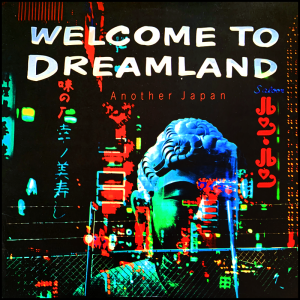
This combination of danger and fun metaphorically symbolizes the compilation album Welcome to Dreamland: Another Japan. Released on the Celluloid Records label and curated by British avant-garde pioneer Fred Frith, the album contains fourteen tracks representing a variety of contributions from Japanese artists. The material ranges from fascinating to challenging, alternating at times between the beautifully quirky and the jaw-dropping bizarre.
Background
Celluloid Records was founded in 1976 by Jean Georgekarakos (more commonly known as Jean Karakos), a French-born Greek music producer who played a pivotal role in nurturing the experimental no-wave scene in New York. Karakos had previously run a chain of record stores in France and formed the jazz label BYG Records in 1967.
Many of the early Celluloid albums were released under the guidance of Bill Laswell, who operated as a sort of in-house talent scout and record producer. During the label’s formative years, Celluloid embraced a raw and challenging caliber of musical expression that led to the signing of such artists as James Chance & the Contortions, Lydia Lunch, and the Lounge Lizards. Along with releases by Laswell’s own group Material, Celluloid’s roster included Afrika Bambaataa & The Soulsonic Force, The Last Poets, the Golden Palominos, and Fela Aníkúlápó Kuti. Celluloid artists intertwined punk, jazz, avant-garde, hip-hop, and electronic music into an unpredictable mix of forward-thinking experimentation.
Other than its 1985 release date, I don’t know much about Welcome to Dreamland or how it came into existence. Fred Frith is credited as the album’s producer; he also mixed nearly half of the tracks, performed on three of them, and contributed the front cover photograph. Frith had previously been a member of Henry Cow and Material, played with John Zorn in Naked City (who borrowed Japanese lead singer Yamatsuka Eye from the Boredoms), and released several solo albums of experimental guitar works. Known for using a variety of implements to play handmade or modified guitars, one might expect Frith’s unique musical lens to inform which artists would be represented on this release. Although that is very much the case, as with all compilations there is also the odd surprise to be found.
Judging by the price sticker on the back cover, I bought my copy of Welcome to Dreamland at the old Philadelphia Record Exchange. It was probably sometime in the mid 1990s, give or take a few years. I have always been wiling to take a chance on the “various artists” bin in record shops, recognizing that the magic of a compilation album is in its variety. Listening to Welcome to Dreamland again just now, I’d say the ratio between strong and lukewarm material is about on par with my usual expectations of a compilation album. It was fun to revisit these tracks; I’d forgotten how much I really love listening to music that challenges me.
Tracks
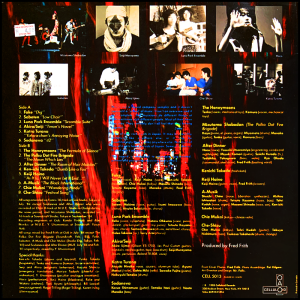
I need to offer a caveat straight away: the track listing and titling on the album jacket and disc labels are known to be out of order, and streaming services compound this error by incorrectly splitting and joining a few tracks. As a result, I cannot guarantee absolute accuracy below. That being said, I researched each artist to verify as many tracks as I could. I also considered the helpful performer credits in the liner notes; only three songs feature saxophone, for example, so that made track identification relatively easier. In a few cases, I was able to view a live performance on YouTube by the actual artist. I feel reasonably confident that I have all but three tracks locked as verified. On the remainder, I did my best imitation of a musical anthropologist to determine which tracks were whose.
Leading off this album (I think) is “The Formula of Silence” by the Honeymoons. The track begins with about a minute of rotating vocals against an industrial machine gun rhythm, performed using (checks the liner notes again) mechanical toys. It sounds like some sort of metallic percussion cycling against the vocals, which together create quite a disturbing atmosphere. It’s difficult to glean whether the intention is to convey ecstasy or horror, and maybe that dichotomy is the point. The track ends with more mechanical toy gunfire accompanied by a staccato call-and-response between the vocalists.
That’s followed by “The Moon Which Lies” by Mizutama Shobodan, otherwise known as The Polka Dot Fire Brigade. The song is a relatively straightforward guitar-bass-drums number that recalls the heyday of early 1980s post-punk. If one were to replace vocalist Tenko with Paul Weller, in fact, this track could almost pass as an early Jam outtake—minus the shrieking at the end, of course.
The members of After Dinner then offer the quiet and pretty “The Room of Hair Mobiles,” which demonstrates a slightly warped Burt Bacharach influence. Against a background of chirping cicadas and nightingales, we hear a lovely blend of steel drums, guitar, violin, and traditional Japanese instruments. The lead vocals by Haco are appealingly childlike and bring to mind innocent summer days. One of the album’s winners.
I believe the next track is by Japanese noise legend Keiji Haino, entitled “As It Is, I Will Never Let It End …” There is some backwards tape looping, lots of dissonant guitar strumming, and the occasional anguished yelp. Just to drive the point home, the final twenty seconds features lots of broken strings and screaming. I’m somewhat familiar with Haino’s work, so this aligns with the sort of thing I would expect from him. According to the liner notes, Fred Frith played scissors on this piece. Enjoy.
I’m somewhat less certain about the next track, which I believe is “The Black International” performed by a collective of Japanese artists who called themselves A-Musik. The piece starts off as a sort of drunken sea chanty, then halfway through we get a strangulated synthesizer or organ solo joined by a crazed violin. It sounds like a joke we’re not supposed to get.
If you’re listening to this album on Spotify, that track is combined with “Wandering Hindu” by Chie Mukai. This ghostly drone played on kokyū might be the most traditional sounding piece on the album. Haunting and compelling.
Side one ends with “Festival Song” by Che-Shizu, a four-piece group consisting of guitar, bass, drums, and kokyū. The track labors and lurches, held together by Takuha Nishimura’s bass lines. The song somewhat resembles a broken Red Krayola piece, especially near the end when everything shatters into disarray. It might be by design, or they may have simply gotten tired and stopped playing.
Flip the record over, and Side two kicks off (I believe) with “Dig” by another loose collective of artists. This time the names comprise many of the performers already mentioned, including Frith and Haino. If you’re familiar with Frith’s work in Massacre or his early solo albums (think Gravity or Speechless, or his collaboration with Henry Kaiser entitled With Enemies Like These, Who Needs Friends?), this piece falls within that same ballpark. Haino’s vocals rest upon a start-stop bass-heavy rhythm, with blurts of sax and all sorts of noises fluttering around the perimeter.
That’s followed by “Low Chair” by Saboten, another guitar-bass-drums outfit with brittle post-punk overtones. The drumming is spry, the guitars are prickly, the bass produces a bouncy little melody, and the vocals have a pleasant 1960s girl-group flavor. I was reminded a bit of Shonen Knife.
The next track is “Scramble Suite” by Luna Park Ensemble. In a scant three minutes, this entertaining piece of musical theater covers a wide terrain of styles: stylistic pop, glitzy showtune, heavy prog, bass-poppin’ funk, and elegant barbershop waltz. It sounds like what would happen if The Sound of Music took place in Shibuya-kei and starred Maki Nomiya from Pizzicato Five.
I believe that leads into the album’s most bizarre track, “Timon’s Navel” by Seiji Murayama and Akira Iijima. (I’ve seen the piece alternatively titled “Timon’s Novel”). There are strange vocals, random percussion noises, plinks of mandolin, treated guitars spewing feedback, and a Roland TR-808 bing-bonging crazily in the background.
Things don’t calm down with the arrival of “Dumb Like a Fox” by Ken-Ichi Takeda. Based solely on my research (which includes watching a decades-old performance thankfully preserved on YouTube), I believe the artist is playing a modified taishokoto with tape accompaniment. Recorded with lots of clatter and groan, this interesting but endurance-defying piece falls under the category of “acquired taste.”
We are then treated to “Yatara-chan’s Annoying Noise” by Katra Turana. The annoying part is the vocal, which is a pity because I quite like tune instrumentally. The pace is brisk, and the song features lovely bits of violin, piano, cello, and percussion. The vocals are pretty cringe, however, and one suspects that was the point. Several Katra Turana releases can be found online; assuming that it is indeed Katra Turana who recorded this track, the group’s other output sounds much better to these ears.
The album closes with “42” by a band called Sodaneva. A model of elegant simplicity, the track is built around a twin-guitar melody (shared by Kazuo Shimamura and Tomoko Itani) supported by supple bass played by Naoto Manabe. Somewhat recalling Vini Reilly’s playing in the Durutti Column, this wonderful little piece makes its point quickly before retreating into silence. Another album highlight that ends too soon for me.
Aftermath
Celluloid closed up shop in 1989, leaving behind a strong legacy as a musical trailblazer among record labels. Karakos returned to Paris that same year, and soon afterward he was responsible for kickstarting the Lambada record label and dance movement in Europe. After a few years of legal wrangling, plus a debt recovery effort that took decades to resolve, Karakos bought back the rights to the Celluloid catalogue in 2023. Today Celluloid is part of the Karakos Productions & Publishing portfolio.
Other than Keiji Haino, I’m not certain what ultimately became of most of these artists. That is likely due to my Western White Male bias, and that’s kind of a shame, because I think would like to hear more from After Dinner and Sodaneva. A quick browse on Discogs turned up at least a few releases from most of the contributors represented on Welcome to Dreamland. If mid-1980s Japanese avant-garde is your musical obsession, then the garden is wide open (just be prepared to spend a bit of money; prices of Japanese imports tend to be quite steep). For those who are simply curious, this uneven but eclectic compilation might be a more economical place to start.
Reply